Trapdoor Spider Identification Guide
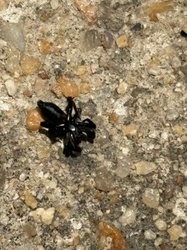
Identify the trapdoor spider by its stocky, dark body and the camouflaged, hinged silk door concealing its burrow.
Read the full Trapdoor Spider encyclopedia entry →Key Visual Features
Trapdoor spiders are stocky, burrow-dwelling spiders best recognized by their construction work as much as their appearance:
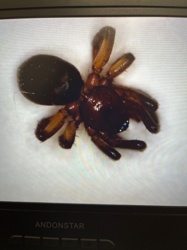
- Color: Dark brown to blackish body, sometimes with a slight sheen, blending well with soil and leaf litter.
- Body shape: A compact, robust body with a rounded abdomen and a thick carapace, giving a somewhat tarantula-like impression on a smaller scale.
- Size: Body length typically 0.75-1.5 inches depending on species, with short, powerful legs built for digging rather than running.
- Legs: Stout and muscular, often with thickened front legs adapted for excavating soil.
- Fangs: Strong, downward-pointing fangs used for digging and for gripping prey that approaches the burrow entrance.
Where and When You'll See One
The defining feature of this species isn't the spider itself, which is rarely seen in the open, but its burrow: a vertical tunnel dug into compact soil and sealed with a camouflaged, hinged silk-and-soil lid that blends seamlessly with the surrounding ground. The spider waits just beneath the door, sensing vibrations from passing prey, and quickly opens it to ambush before retreating back inside. Burrows are most often found in banks, slopes, and undisturbed soil in gardens, woodlands, and grassy areas, with the trapdoor most visible after rain when the surrounding soil is damp and the silk hinge stands out slightly.
Similar-Looking Spiders
- Funnel-web spiders: Also dig burrows but leave an open, funnel-shaped entrance with radiating trip-line silk rather than a hinged, camouflaged lid.
- Wolf spiders: Some wolf spider species dig simple burrows too, but these lack the engineered, hinged door and are usually just an open tunnel entrance.
- Tarantulas: Larger and hairier overall, and while some tarantula species also burrow, most do not build a hinged trapdoor lid.
Quick ID Checklist
- Stocky, dark brown to black body with a thick carapace
- Short, powerful, digging-adapted front legs
- Vertical burrow sealed with a camouflaged, hinged silk-and-soil door
- Spider rarely seen above ground, waiting just beneath the door
- Burrow found in compact soil banks, slopes, or undisturbed ground
Frequently asked questions
How do I find a trapdoor spider's burrow if the spider stays hidden?
Look for a small, camouflaged circular or oval lid on compact soil, often on a slope or bank, that may show a faint silk hinge along one edge, especially after rain.
What makes the trapdoor different from a funnel-web spider's burrow?
A trapdoor spider seals its tunnel with a hinged, well-camouflaged lid, while a funnel-web spider leaves its burrow entrance open with silk trip-lines radiating outward.
Why are trapdoor spiders rarely seen out in the open?
They are ambush predators that spend nearly all their time in their burrow, only opening the door briefly to grab passing prey before retreating.
What kind of soil do trapdoor spiders prefer for burrowing?
They favor compact, well-drained soil on banks or slopes that can hold a stable vertical tunnel shape without collapsing.
Trapdoor Spider identified by the community
Recent Trapdoor Spider finds identified with Bug Identifier.