Wall Spider Identification Guide
Recognize wall spiders by their flattened bodies and habit of resting motionless on vertical surfaces.
Read the full Wall Spider encyclopedia entry →Key Visual Features
Wall spiders are small, flat-bodied spiders adapted for living on vertical surfaces such as walls and rock faces.
- Size: Compact, usually 4 to 8 mm in body length.
- Body shape: Notably flattened cephalothorax and abdomen, an adaptation that lets them squeeze into narrow crevices.
- Color: Mottled gray, brown, or tan patterns that closely resemble stone, bark, or plaster surfaces, providing effective camouflage.
- Legs: Moderately long and spread outward, allowing quick, crab-like sideways movement across flat surfaces.
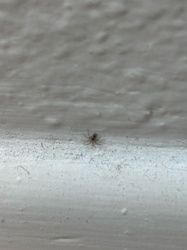
- Behavior marker: Often seen sitting perfectly still and flush against a wall or rock rather than in an open web.
Where and When You'd See One
Wall spiders are named for their strong association with vertical surfaces.
- Exterior walls, stone or brick surfaces, rock faces, and cliffs
- Around window frames, under eaves, and in crevices in masonry
- Most visible in daylight, since they rest openly on walls rather than hiding in silk retreats
- Active in warmer months, though sheltered individuals may be seen year-round in mild climates
Similar-Looking Bugs
- Crab spiders also have a flattened, sideways-moving body but are usually found on flowers and foliage rather than bare walls.
- Huntsman spiders are much larger with a similar flattened shape but favor tree bark and indoor walls at a bigger scale.
- Jumping spiders may also rest on walls but have a distinctly compact, stocky body and large forward-facing eyes, unlike the flat, camouflaged look of a wall spider.
- Cave spiders have much longer legs and a less flattened body, and prefer dark, enclosed spaces rather than open wall surfaces.
Quick ID Checklist
- Flattened body pressed close to a vertical surface
- Mottled coloring that blends with stone, bark, or plaster
- Quick, sideways scuttling movement when disturbed
- Found resting motionless on exterior walls or rock faces
- No visible web at the resting spot
Frequently asked questions
Why are wall spiders flat?
Their flattened body shape lets them press tightly against vertical surfaces and squeeze into narrow crevices for shelter.
Do wall spiders build webs?
They rely more on camouflage and speed than on a web, often resting in the open on walls rather than inside a silk structure.
How do wall spiders move?
They tend to scuttle quickly sideways across flat surfaces when disturbed, similar to a crab spider's movement.
Where is the best place to spot a wall spider?
Look on exterior brick or stone walls, around window frames, and on rock faces where their mottled coloring blends in.
Wall Spider identified by the community
Recent Wall Spider finds identified with Bug Identifier.