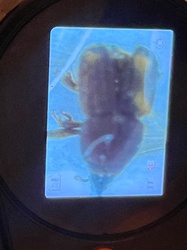
Water Boatman Bug Identification Guide
A small, oar-legged pond dweller that swims right-side up and grazes on algae along the bottom.
Read the full Water Boatman Bug encyclopedia entry →Key Visual Features
- Small, oval, flattened body typically 0.2-0.6 inches (5-15 mm) long
- Mottled brown, tan, or gray coloring on the back, often with fine dark crosswise lines
- Distinctly oar-shaped hind legs fringed with long hairs, used for swimming
- Short, scoop-like front legs used for scraping food from surfaces
- Middle legs are long and slender, used for gripping submerged plants or debris
- Convex, streamlined back with folded wings that give a smooth, rounded profile
- No visible piercing beak extending far forward, unlike some other water bugs
Where and When You'll See It
Water boatmen are common in ponds, lakes, slow streams, and even temporary pools with soft mud or plant debris on the bottom. They swim in an upright, right-side-up position (unlike backswimmers) and are often seen darting through open water or resting near the bottom among sediment and algae. They are active from spring through fall in temperate regions and can appear in large numbers in nutrient-rich water. On warm evenings they sometimes fly between water bodies and can be drawn to lights. Many species also produce a faint chirping or clicking sound by rubbing a front leg against the head, a behavior that can help confirm identification even before the insect is clearly seen. Large groups can often be observed swimming together near shallow, sunlit margins of a pond.
Similar-Looking Bugs
- Backswimmer: swims upside down with its back toward the bottom, has a more sharply keeled back, and lacks the mottled boatman pattern.
- Creeping water bug: has thicker, more robust raptorial front legs for grabbing prey, rather than the boatman's small scoop-shaped front legs.
- Water strider: skates on top of the water surface rather than swimming within it, with much longer, thinner legs.
- Diving beetle: has a harder, shinier, more domed shell and clubbed antennae tucked under the head, versus the boatman's flatter, duller body.
Quick ID Checklist
- Swims right-side up (back facing up)
- Mottled brown/tan patterned, flattened oval back
- Oar-like, hair-fringed hind legs
- Small, scoop-shaped front legs
- Found in still or slow water with mud, plants, or algae on the bottom
Frequently asked questions
How do I tell a water boatman from a backswimmer?
Orientation is the easiest clue: a water boatman swims right-side up with its back facing the surface, while a backswimmer swims upside down with its pale belly facing up. Boatmen also have a mottled patterned back, while backswimmers are more uniformly colored.
What color is a water boatman?
Most water boatmen have a brown, tan, or grayish back marked with fine, wavy dark lines that create a mottled or crosshatched pattern, which helps them blend in with mud and debris.
Where in a pond would I find water boatmen?
They are typically found near the bottom of ponds, lakes, or slow-moving water among mud, algae, and decaying plant matter, though they also swim actively through open water.
Do water boatmen fly?
Yes, adults have functional wings folded over their back and can fly between water bodies, particularly during warm weather, and may be attracted to outdoor lighting at night.
Water Boatman Bug identified by the community
Recent Water Boatman Bug finds identified with Bug Identifier.