
Water Flea Identification Guide
Learn to spot these tiny, jerky-swimming crustaceans by their translucent rounded shell and single large antennae used for propulsion.
Read the full Water Flea encyclopedia entry →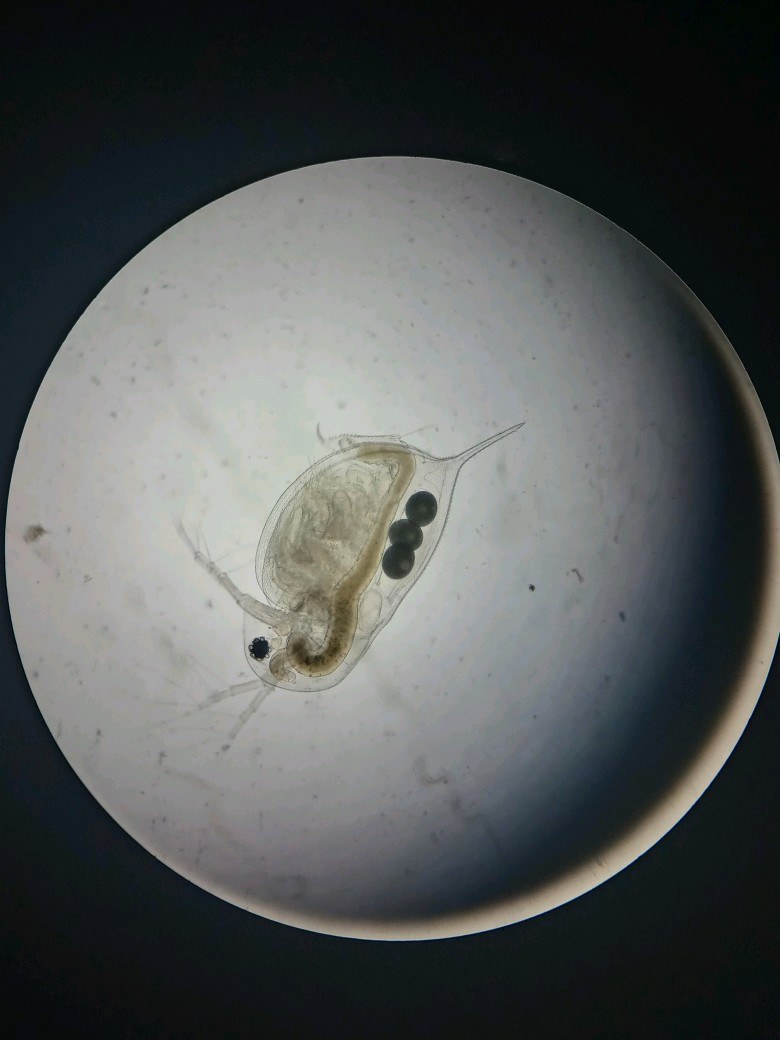
Key Visual Features
Water fleas are minute freshwater crustaceans, not true insects, best known for their jerky swimming motion that resembles a flea's hop.
- Size: Very small, generally 0.5-3 mm long, visible to the naked eye mainly as tiny moving specks in a water sample.
- Color: Mostly translucent to pale grey or greenish, sometimes with a faint pinkish or brownish tint depending on diet; internal organs and the developing eggs (in females) are often visible through the transparent shell.
- Body shape: A rounded to oval body enclosed within a single-piece, semi-transparent carapace (shell) that resembles a tiny bean or comma shape, with the head projecting out at one end.
- Antennae: A pair of large, prominent, branched antennae extend from the head — much larger relative to the body than in most other small aquatic creatures — and are the main tool used for swimming.
- Movement: Water fleas swim with a distinctive jerky, hopping motion, rowing themselves through the water in short bursts using the large antennae, rather than a smooth continuous glide.
- Eye: A single, large, dark compound eye is often visible near the front of the head, sometimes appearing as a conspicuous black dot.
Where and When You'd See It
Water fleas are abundant in still or slow-moving freshwater such as ponds, lakes, and vegetated ditches, often forming dense swarms visible as clouds of tiny moving dots in sunlit water. Populations peak in warmer months, spring through autumn, when they reproduce rapidly. They are most easily observed by looking closely at a jar of pond water held up to the light.
Similar-Looking Bugs
- Water springtails: Rest and walk on the water's surface film rather than swimming within the water column, and have an elongated soft body instead of a rounded shell.
- Seed shrimp (ostracods): Also small and shelled, but their shell is hinged and clam-like, fully enclosing the body on both sides, unlike the more open, comma-shaped carapace of water fleas.
- Mosquito larvae: Much larger and more elongated, wriggling near the surface rather than hopping through open water.
Quick ID Checklist
- Tiny (under 3 mm), translucent, rounded to comma-shaped body
- Large, branched antennae used for jerky, hopping swimming
- Single prominent dark eye near the front of the head
- Often seen in dense swarms in still, sunlit pond water
- Semi-transparent shell may reveal internal organs or eggs
Frequently asked questions
Why is the water flea's swimming motion a useful identification clue?
Its jerky, hopping style of swimming, powered by large branched antennae, is distinctive and gives the group its common name, setting it apart from the smoother movements of other tiny pond organisms.
How can you tell a water flea from an ostracod (seed shrimp) in a water sample?
A water flea has an open, comma-shaped shell with the head and large antennae projecting out, while an ostracod has a fully enclosed, hinged, clam-like shell that hides the body almost entirely.
What makes the water flea's eye noticeable?
It has a single large, dark compound eye near the front of the head that often stands out clearly against the mostly translucent body, especially under magnification.
When are water fleas most abundant in a pond?
Populations typically peak during the warmer months from spring through autumn, when they can form dense, visible swarms in sunlit water.