
Webbing Clothes Moth Identification Guide
Learn to recognize the small, golden, plain-winged moth that avoids light and leaves silk webbing behind on fabric.
Read the full Webbing Clothes Moth encyclopedia entry →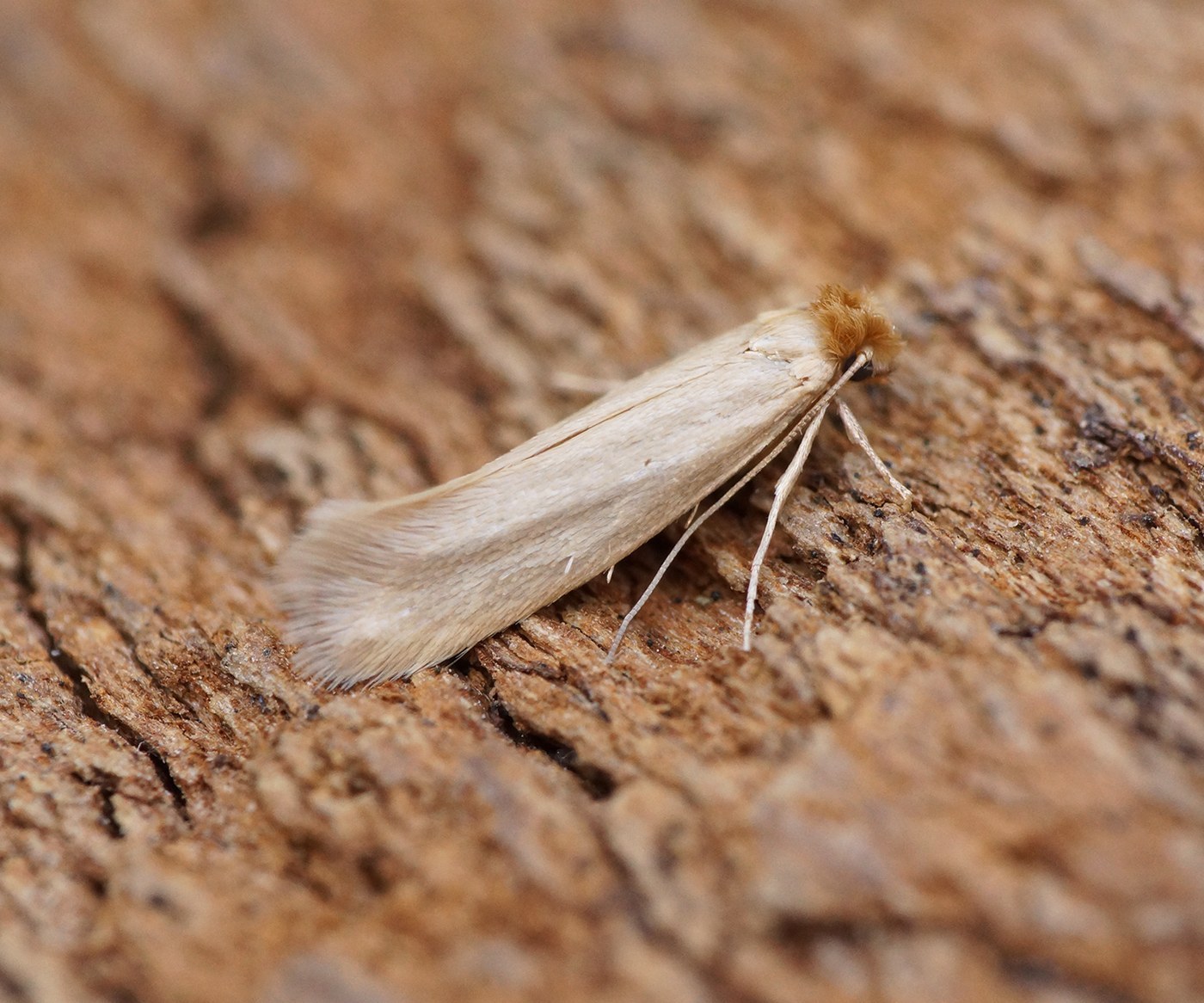
Key Visual Features
The webbing clothes moth (Tineola bisselliella) is a small, light-shy moth with an understated, uniform appearance.
- Size: Wingspan of roughly 9-16 mm, giving it a noticeably small, delicate build.
- Color: Solid golden-tan to buff-colored wings with a slight satiny sheen, lacking spots, bands, or bold markings.
- Head: Covered in tufts of reddish-golden hair-like scales, slightly shaggier than the rest of the body.
- Wings: Narrow and fringed with fine hair-like scales along the edges; when at rest, the wings fold flat and close along the body, giving a slim, elongated silhouette.
- Behavior in flight: Weak, fluttering flyer that tends to run or scuttle rather than fly when disturbed, and generally avoids bright light.
- Larvae: Small, white to cream caterpillars that spin silk webbing directly onto the surface of fabric as they feed, rather than building a portable case.
Where and When You'd See It
This species is found indoors, typically in dim, undisturbed areas such as closets, storage boxes, and under furniture where natural fiber textiles are kept. Adults actively avoid light and are more often found in shadowed corners than near windows. Activity can occur year-round indoors but tends to be more noticeable in warmer months. Fine, loosely spun silk webbing directly on the surface of fabric, sometimes with small feeding holes nearby, is a strong sign of this species.
Similar-Looking Bugs
- Casemaking clothes moth: Very similar in size and color, but its larvae build and carry a small, portable silken case around themselves rather than spinning webbing directly onto fabric.
- Indianmeal moth: Larger, with a clearly two-toned wing (pale base, coppery tip), and associated with stored food rather than fabric.
- Grain moths: Generally paler and more uniform, found around stored grain products instead of textiles.
Quick ID Checklist
- Small moth (9-16 mm wingspan) with solid golden-tan, unmarked wings
- Reddish-golden tufted hairs on the head
- Weak flier that tends to scurry away from light rather than fly toward it
- Larvae spin flat silk webbing directly onto fabric surfaces
- Found in dim, undisturbed indoor spots like closets and storage boxes
Frequently asked questions
How do I tell a webbing clothes moth from a casemaking clothes moth?
The clearest difference is in the larval stage: webbing clothes moth larvae spin flat silk webbing directly on fabric, while casemaking clothes moth larvae build and drag around a small, portable silken case.
Why do webbing clothes moths avoid light?
This species has a strong tendency to stay in dim, undisturbed areas, which is why it's more often found tucked into closets or storage boxes rather than fluttering near windows like many other moths.
What does webbing clothes moth silk look like?
It appears as thin, loosely woven, semi-transparent silk strands laid flat across the surface of fabric, often near areas of visible feeding damage.
Are webbing clothes moths strong fliers?
No, they are weak, fluttery fliers and more often scuttle or run for cover when disturbed rather than taking sustained flight.