
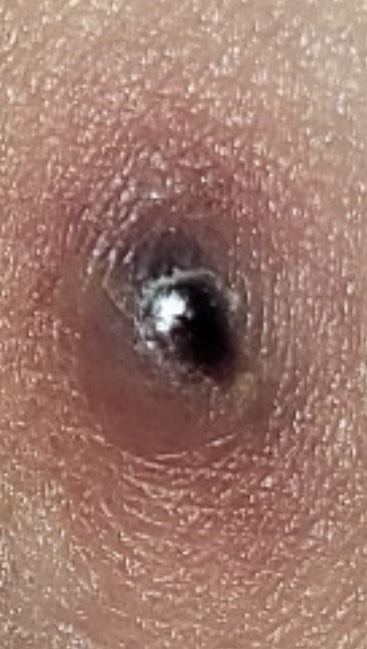
Community identification
Likely a tick (possibly a tiny or partially embedded tick); the image is not detailed enough for exact identification.
Unidentified tick; species cannot be determined from the image.
- Order & Family
- Ixodida; likely Ixodidae (hard ticks).
- Size
- Usually about 1–5 mm unfed, depending on species and life stage; larger after feeding.
Natural Habitat
Ticks occur in vegetation, leaf litter, and animal nests, where they attach to passing hosts.
Diet & Feeding
Blood-feeding parasite of mammals, birds, reptiles, or amphibians.
Behavior Patterns
Waits on vegetation or crawls through host habitat, then attaches and feeds for hours to days; life cycle typically includes larval, nymphal, and adult stages.
Risks & Benefits
Some species transmit diseases to people and animals. They also serve as food for wildlife; avoid squeezing or crushing an attached tick, and remove it promptly with fine-tipped tweezers.