American Dagger Moth Caterpillar Identification Guide
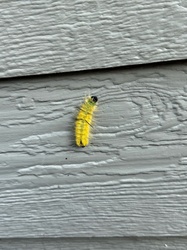
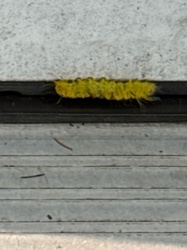
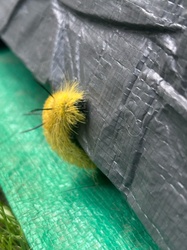
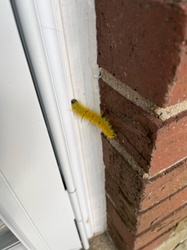
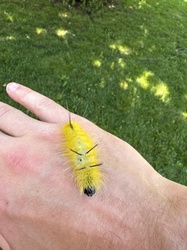
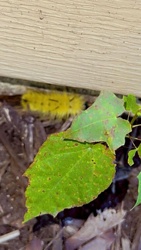
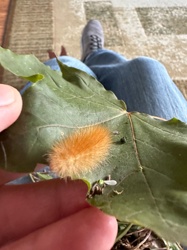
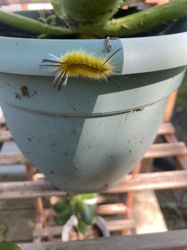
Identify this fuzzy pale-yellow caterpillar by its dense coat of soft hairs and long black tufts near the head and tail.
Read the full American Dagger Moth Caterpillar encyclopedia entry →Key Visual Features
The American dagger moth caterpillar is a fuzzy, densely haired caterpillar in the genus Acronicta, easy to notice thanks to its pale color and prominent black hair tufts.
- Body color: Pale yellow to cream, sometimes with a slightly greenish tint, densely covered in long, soft, pale setae (hairs) that give the whole body a fuzzy, almost fur-like appearance.
- Black tufts: Several long, black hair-pencils project from the body — typically one or two near the head end and another near the rear, standing out sharply against the pale body hair.
- Body shape: Cylindrical and plump, tapering slightly at both ends, with the dense hair coat obscuring the true body outline.
- Size: Reaches about 2 inches (5 cm) at full growth.
- Head: Small and dark, mostly hidden by the surrounding hair.
Where and When You'll See It
American dagger moth caterpillars feed on a variety of deciduous trees, including maple, oak, elm, walnut, birch, and hickory. They are found across much of the eastern and central United States and southern Canada, most commonly seen from late summer through fall as they reach their final larval stage and wander in search of a pupation site.
Similar-Looking Caterpillars
- Other Acronicta (dagger moth) species: Many have similar hairy bodies with black tufts, but colors and the exact placement of tufts differ; the American dagger moth's especially pale, cream-yellow body helps distinguish it.
- Tussock moth caterpillars: Also have tufts of hair, but typically arranged in more organized "toothbrush" tufts along the back plus longer hair pencils projecting from the head and tail in a more structured pattern, often combined with brighter body colors.
- Sycamore tussock moth caterpillar: Similar pale, fuzzy appearance, but usually shows more gray tones and less contrast between body hair and black tufts.
Quick ID Checklist
- Pale yellow to cream body densely covered in soft hair
- One or two long black hair-pencil tufts near the head
- An additional black hair tuft near the rear of the body
- Plump, cylindrical shape roughly 2 inches long at maturity
- Found on maple, oak, elm, or walnut leaves in late summer and fall
Frequently asked questions
What is the easiest way to tell an American dagger moth caterpillar apart from other hairy caterpillars?
Look for the combination of an overall pale yellow-cream body with distinct long black hair tufts concentrated near the head and rear rather than spread evenly.
What trees are American dagger moth caterpillars most often found on?
They feed on many deciduous hardwoods, with maple, oak, elm, and walnut being especially common hosts.
When during the year are these caterpillars most visible?
They are most frequently spotted from late summer into fall, when larvae are largest and often moving in search of a place to pupate.
What does the adult American dagger moth look like?
The adult is a grayish moth with subtle dagger-shaped dark markings on the forewings, quite different from the fuzzy, pale larval form.
American Dagger Moth Caterpillar identified by the community
Recent American Dagger Moth Caterpillar finds identified with Bug Identifier.