Argentine Ant Identification Guide
Identify the Argentine Ant by its small size, uniform light-to-dark brown color, and dense foraging trails.
Read the full Argentine Ant encyclopedia entry →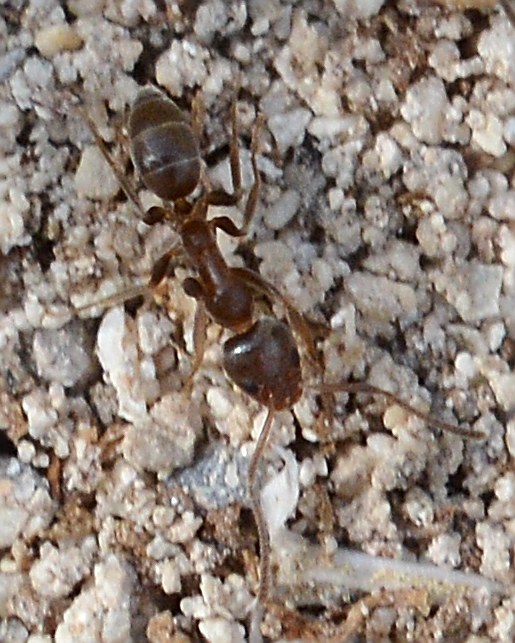
Key Visual Features
- Small ant, only about 2.2-2.8 mm long, with a slender, uniformly colored light brown to dark brown body.
- Body lacks any strong contrasting bands or markings, appearing evenly colored from head to abdomen.
- Waist has a single upright node (petiole segment) that is small and not easily seen without magnification.
- Antennae are 12-segmented and lack a distinct club at the tip, giving them a fairly uniform thin appearance.
- Body surface appears smooth with only faint hairs, and the ant lacks a stinger, relying on chemical defenses instead.
Where and When You're Likely to See It
- Originally from South America, now widely established in warm-temperate and Mediterranean-type climates around the world, including many urban and suburban areas.
- Commonly found nesting in shallow soil under stones, mulch, logs, or pavement edges, as well as inside wall voids and other sheltered spots near buildings.
- Forms extensive, high-density foraging trails, with workers moving in continuous, unbroken lines along edges of sidewalks, walls, and plant stems.
- Active year-round in mild climates, with peak activity in warm months and a tendency to move indoors during hot, dry, or very wet weather.
- Colonies are unusual in forming enormous interconnected "supercolonies" with many cooperating nests rather than single, isolated colonies.
Similar-Looking Species
- Odorous house ants are similar in size and color but have an unevenly shaped thorax when viewed from the side and a distinctive smell when crushed, unlike the smoother-profiled Argentine ant.
- Pavement ants are slightly larger, darker, and have a pair of small spines on the thorax that Argentine ants lack.
- Pharaoh ants are smaller still and pale yellow-orange rather than brown.
- Carpenter ants are much larger with a single evenly rounded thorax profile and a much bigger overall body size.
Quick ID Checklist
- Small (2-3 mm), uniformly light-to-dark brown, unmarked body.
- Single small upright node at the waist.
- No distinct antennal club; smooth, faintly haired body.
- Dense, continuous foraging trails along edges and surfaces.
- Nests in shallow soil, mulch, or under debris near structures.
Frequently asked questions
How can I tell an Argentine Ant from an odorous house ant?
Argentine ants have a smoother, more evenly profiled thorax, while odorous house ants have an unevenly shaped thorax and release a distinct smell when disturbed.
Why do Argentine Ants form such large, dense trails?
Colonies cooperate across many interconnected nests forming supercolonies, so large numbers of workers travel together along shared foraging trails.
Where do Argentine Ants typically build their nests?
They favor shallow nests in moist soil, under stones, mulch, or logs, and often close to building foundations or pavement edges.
Does the Argentine Ant have a stinger?
No, it lacks a functional stinger and relies on other means, such as biting or chemical secretions, when disturbed.
Argentine Ant identified by the community
Recent Argentine Ant finds identified with Bug Identifier.