Black Fly Larva Identification Guide
A tiny, club-shaped larva that anchors itself to submerged rocks in swift streams and filters food from the current with fan-like head bristles.
Read the full Black Fly Larva encyclopedia entry →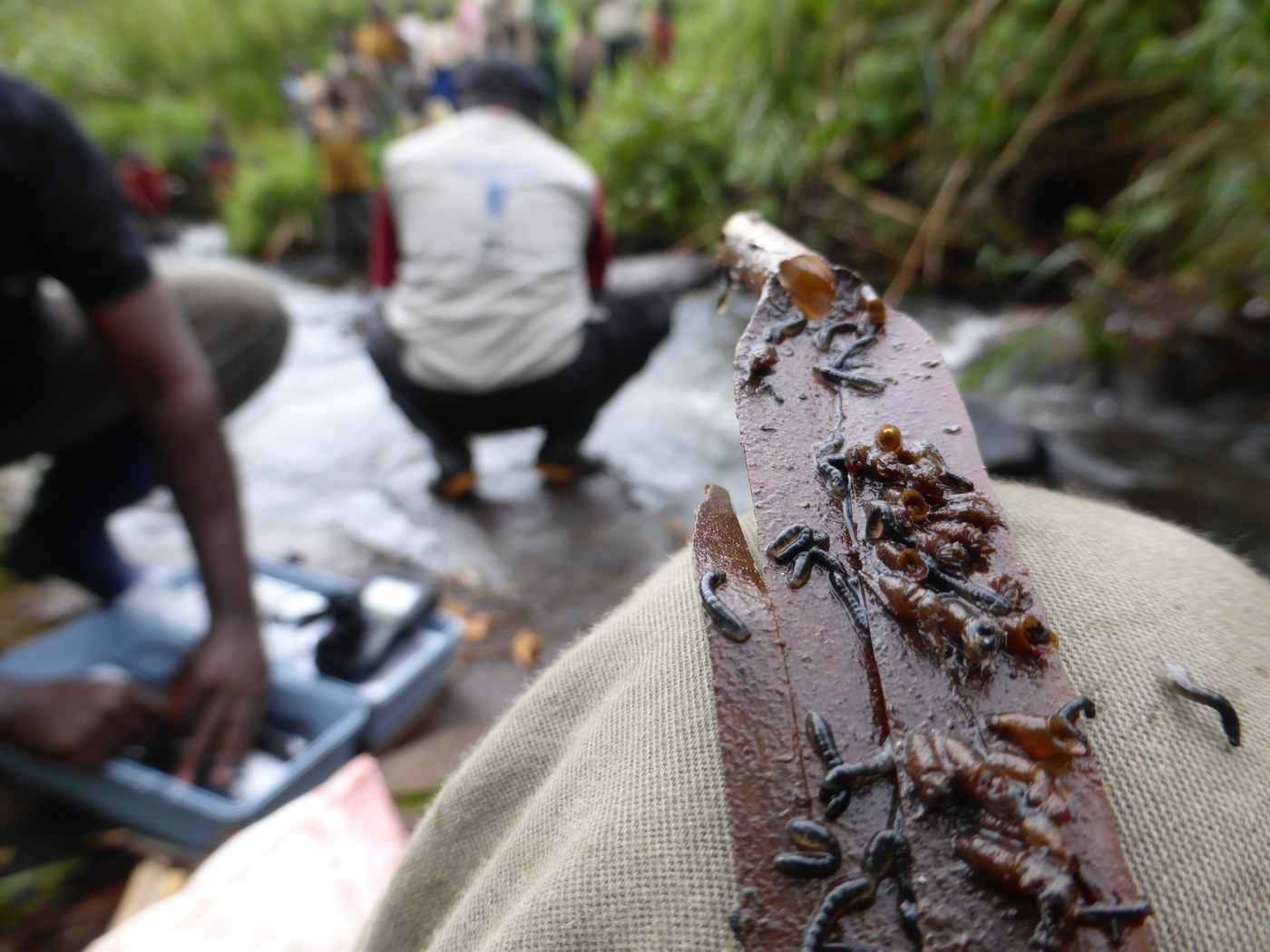
Key Visual Features
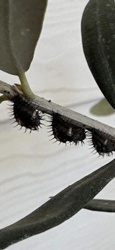
- Small, club or bowling-pin shaped body, typically 0.15-0.4 inches (4-10 mm) long
- Body widens gradually from a narrow front end to a bulbous rear end
- Grayish, brownish, or blackish coloring, sometimes with a translucent quality
- Pair of fan-like structures (labral fans) at the head, spread open to filter tiny food particles from flowing water
- A single proleg near the front and a ring of small hooks at the rear end, used to anchor to silk pads on rocks
- Body attached to a submerged surface by a silken thread, allowing it to sway with the current without being swept away
- No legs in the traditional sense, consistent with its identity as a fly larva
Where and When You'll See It
Black fly larvae are found firmly attached to rocks, submerged logs, or vegetation in fast-flowing, well-oxygenated streams and rivers, particularly in riffles where current speed is highest. They anchor themselves with a silken pad and posterior hooks, orienting their bodies into the current and extending their fan-like head structures to strain out tiny food particles carried by the flow. They are most commonly found from spring through fall, often in dense clusters covering the surface of submerged rocks in swift-moving sections of a stream.
Similar-Looking Bugs
- Non-biting midge larva (bloodworm): thin, worm-like, and typically red, without the black fly's characteristic club shape or head fans.
- Crane fly larva: much larger, cylindrical, and leathery-skinned, without the distinctive bulbous rear end or filtering head fans.
- Net-spinning caddisfly larva: builds a silk capture net rather than using fan-like head structures, and often has a soft caterpillar-like body inside a shelter.
- Mosquito larva: found hanging from the still water surface rather than anchored to rocks in fast current, and lacks the club-shaped body.
Quick ID Checklist
- Small, club or bowling-pin shaped body
- Fan-like filtering structures visible at the head
- Anchored to submerged rocks via a silk pad and rear hooks
- Found in clusters on rocks within fast-flowing, riffle sections of streams
- Grayish to blackish coloring
Frequently asked questions
What are the fan-like structures on a black fly larva's head?
These are labral fans, which the larva extends into the current to filter tiny food particles such as algae and organic debris out of the flowing water.
How does a black fly larva stay attached in fast current?
It spins a small silk pad onto the surface of a submerged rock and grips it with a ring of hooks at the rear of its body, allowing it to sway with the current without being washed away.
Where would I find black fly larvae in a stream?
Look on the surface of submerged rocks and other hard substrates within fast-flowing riffle sections, where they often occur in dense clusters.
How is a black fly larva different from a mosquito larva?
Black fly larvae are club-shaped, anchored to rocks in fast-flowing water, and filter-feed using head fans, while mosquito larvae are more elongated, hang from the still water surface to breathe, and are typically found in calm or standing water.
Black Fly Larva identified by the community
Recent Black Fly Larva finds identified with Bug Identifier.