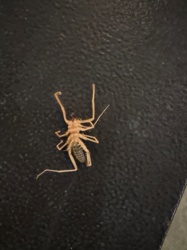
Camel Spider Identification Guide
A fast-moving, hairy desert arachnid with massive jaws, often mistaken for an oversized spider despite belonging to a different arachnid order entirely.
Read the full Camel Spider encyclopedia entry →Key Visual Features
Camel spiders (order Solifugae, sometimes called wind scorpions or sun spiders) are arachnids but not true spiders, easily recognized by their unusual body plan.
- Size: Body length typically 1–2.5 inches (2.5–6 cm), with some larger species reaching up to 6 inches including legs; large for a desert arachnid.
- Color: Tan, sandy-brown, or straw-colored overall, providing camouflage against desert soil and sand.
- Body shape: Distinctly segmented body divided into a large, hairy abdomen and a separate, prominent front section bearing massive jaws — unlike the more fused two-part body of true spiders.
- Jaws (chelicerae): Oversized, pincer-like mouthparts held out in front of the body, often as long as the head itself, used for gripping and processing prey.
- Legs: Ten leg-like appendages total — eight true walking legs plus two long, leg-like pedipalps used for sensing, giving the impression of extra legs.
- Movement: Extremely fast, erratic running, often in short bursts, which contributes to their intimidating reputation.
Where and When You'd See It
Camel spiders are found in arid and desert regions worldwide, including parts of the Middle East, Africa, Asia, and the southwestern United States and Mexico. They are primarily nocturnal, hiding during the heat of the day in burrows, under rocks, or in shaded crevices, and emerging at night to hunt actively on the ground. They are most often encountered after dark in sandy or rocky desert terrain, sometimes attracted to artificial lighting or shaded areas like tents and building shadows during the day.
Similar-Looking Species
- True spiders: Spiders have a two-part body (cephalothorax and abdomen joined by a narrow waist) and eight legs total; camel spiders have a more segmented body and ten leg-like appendages due to the elongated pedipalps.
- Wolf spiders: Similar desert habitat and fast movement, but wolf spiders lack the oversized front jaws and segmented body plan of camel spiders.
- Scorpions: Share the desert habitat but have a narrow tail with a stinger and pincer-like front claws, very different from the camel spider's jaw structure.
- Whip spiders: Also arachnids with long front appendages, but whip spiders have a flattened body and extremely long, whip-like first legs rather than large visible jaws.
Quick ID Checklist
- Sandy tan-brown coloring for desert camouflage
- Oversized, forward-projecting jaws nearly as long as the head
- Segmented body distinct from the fused two-part body of true spiders
- Ten leg-like appendages (eight legs plus two elongated pedipalps)
- Fast, erratic nighttime movement in arid, sandy, or rocky habitats
Frequently asked questions
Is a camel spider actually a spider?
No, camel spiders belong to a separate arachnid order called Solifugae; they are related to spiders but have a distinctly segmented body and different jaw structure, so they are not true spiders.
Why does the camel spider appear to have so many legs?
It has eight true walking legs plus two long, leg-like pedipalps used for sensing its surroundings, which can make it look like it has ten legs at first glance.
What is the most reliable way to identify a camel spider?
Look for the oversized, forward-pointing jaws combined with a segmented, hairy tan body and fast, erratic desert-floor movement — a combination unique among desert arachnids.
When and where are camel spiders most active?
They are mostly nocturnal, hiding in burrows or shaded crevices during the day and becoming active on open sand or rocky ground after dark in arid regions.
Camel Spider identified by the community
Recent Camel Spider finds identified with Bug Identifier.