Dead Leaf Mantis Identification Guide
A flattened, brown praying mantis whose body shape and veined wings closely mimic a dry, fallen leaf.
Read the full Dead Leaf Mantis encyclopedia entry →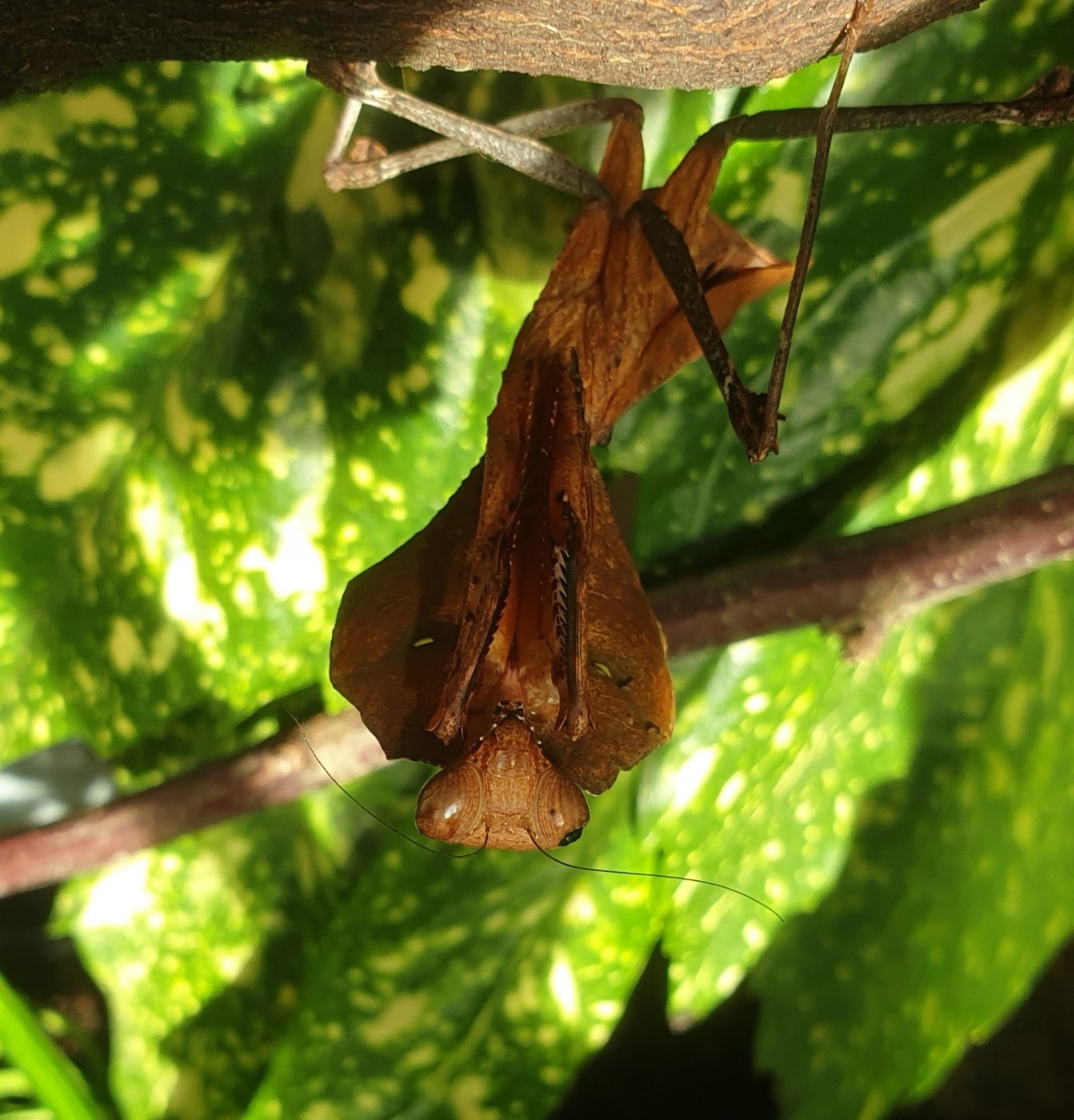
Key Visual Features
The dead leaf mantis (commonly referring to species such as Deroplatys spp.) is a master of camouflage, built to resemble a withered leaf rather than a typical green mantis.
- Size: Medium to large, roughly 2-3.5 inches (5-9 cm) depending on species and sex, with females generally larger and broader than males
- Color: Shades of brown, tan, and rust, sometimes with darker blotches or lighter patches that mimic decay spots or discoloration on a dead leaf
- Body shape: Notably broad and flattened, especially across the thorax and wings, creating an irregular, leaf-like outline rather than the sleek shape of typical mantises
- Wings: Large, broad forewings with pronounced vein-like ridges and textured surface, closely resembling the veins and curled edges of a dried leaf; the wings often have irregular, scalloped edges
- Legs: Front raptorial legs held folded; the legs and sometimes the thorax may have small lobes or flanges that break up the outline further, aiding the leaf disguise
- Head: Triangular head, often held tucked close to the body, blending into the overall leaf-shaped silhouette
Where and When You'd See It
Dead leaf mantises are native to Southeast Asian tropical forests, where they rest on leaf litter, tree trunks, and low vegetation in the humid forest understory. Being tropical, they remain active year-round in their native range, most often seen motionless during the day, relying on camouflage rather than movement, and becoming more active in ambush posture during warm, humid conditions. They are also popular in the exotic pet trade, where they are commonly observed and bred.
Similar-Looking Bugs
- Ghost mantis: Also mimics dead leaves but has a smaller body with more jagged, spiky projections on the thorax and head, giving a rougher, more angular silhouette than the broader dead leaf mantis
- Giant Asian mantis: Typically green or plain brown without the broad, textured, leaf-vein-patterned wings of the dead leaf mantis
- Orchid mantis: Mimics pink/white flowers rather than dry brown leaves, with petal-shaped leg lobes instead of a flattened leaf-shaped body
- Actual dead leaves: The mantis's uncanny resemblance to leaf litter is the point — look for the triangular head, compound eyes, and folded raptorial front legs to confirm it's an insect rather than actual foliage
Quick ID Checklist
- Broad, flattened body with an irregular, leaf-shaped outline
- Brown/tan coloring with vein-like wing texture and scalloped edges
- Larger, bulkier females versus slimmer males
- Head held close to the body, aiding the leaf disguise
- Found motionless on leaf litter or low vegetation in tropical forest understory
Frequently asked questions
What makes the dead leaf mantis such an effective mimic?
Its broad, flattened body and wings have vein-like ridges, scalloped edges, and brown/tan coloring that closely mirror the texture and color of a dried, fallen leaf.
How does it differ from a ghost mantis?
The dead leaf mantis has a broader, smoother leaf-shaped outline, while the ghost mantis shows more jagged, spiky projections on the thorax and head for a rougher look.
Are males and females easy to tell apart?
Yes, females are generally larger and broader-bodied than the slimmer, smaller males.
Where would I encounter one in the wild?
They are native to Southeast Asian tropical forests and are typically found resting motionless among leaf litter or on low vegetation in humid understory habitat.
Dead Leaf Mantis identified by the community
Recent Dead Leaf Mantis finds identified with Bug Identifier.