Gypsy Moth Caterpillar Identification Guide
Distinguish this hairy defoliator by its paired rows of blue and red spots running down its back.
Read the full Gypsy Moth Caterpillar encyclopedia entry →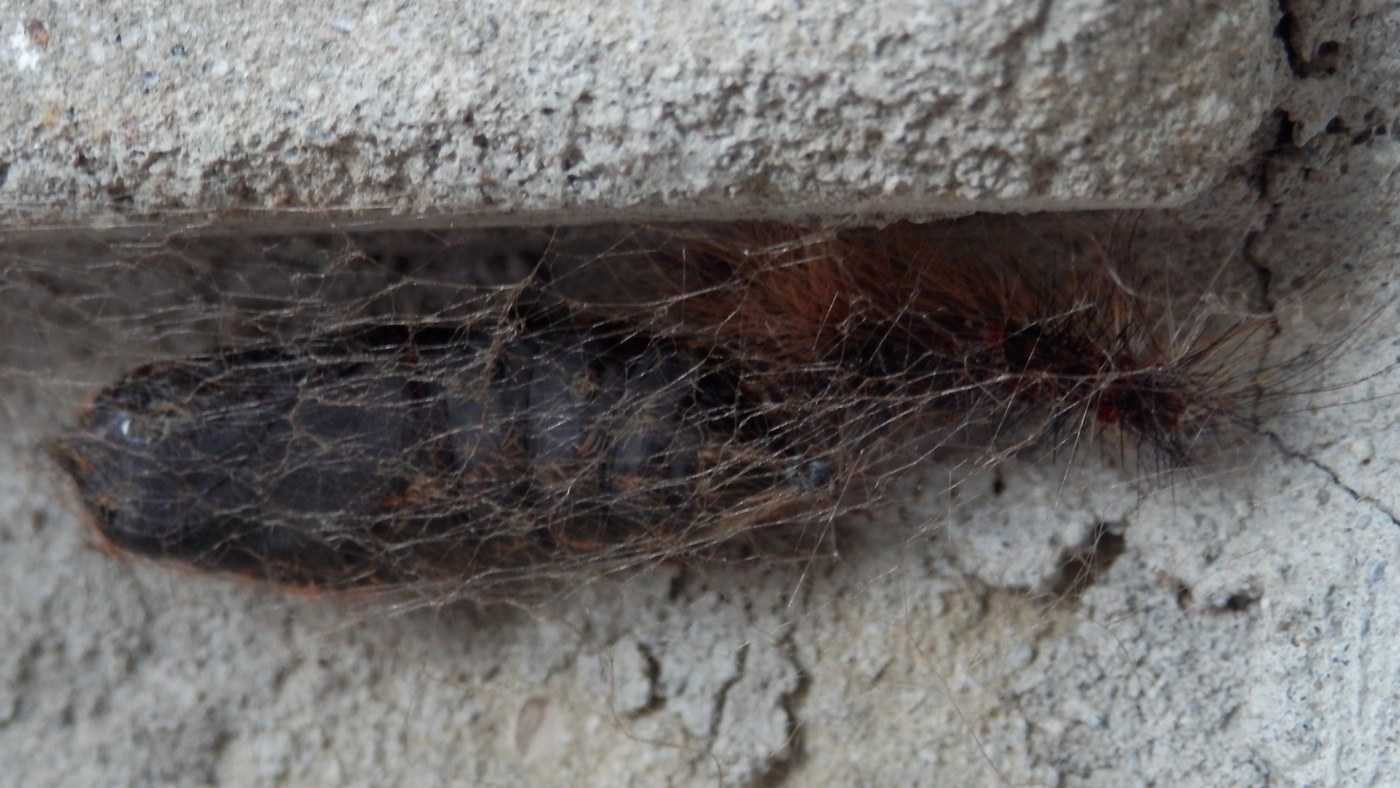
Key Visual Features
The gypsy moth caterpillar (also known as the spongy moth caterpillar) has one of the most distinctive spot patterns among hairy caterpillars.
- Mature larvae grow to about 1.5 to 2.5 inches (4-6 cm) long, with a dark, hairy body covered in tufts of bristly setae arranged in clumps along the back and sides.
- The standout feature is a double row of raised, colored spots down the back: five pairs of blue spots toward the head end followed by six pairs of red spots toward the tail end.
- The head is dark and often marked with pale, blotchy patterning, and young caterpillars are much darker and more uniformly colored before the spot pattern becomes obvious in later stages.
- Adult moths show strong differences between sexes: females are larger, cream to white with faint dark zigzag markings and are nearly flightless, while males are smaller, brownish-gray, and strong fliers with feathery antennae.
- Egg masses are buff to tan colored, fuzzy, and roughly oval, laid in a dense patch on bark, stones, or outdoor structures.
Where and When You'd See It
Gypsy moth caterpillars feed on a wide range of hardwood trees, with oak being a strongly preferred host, though they will use many other species when populations are high. Caterpillars hatch in spring as buds break and feed through late spring into early summer, often ballooning on silk threads to disperse to new trees as tiny larvae. They tend to rest in bark crevices or under branches during the day in later stages, moving up to feed at night, a pattern that helps them avoid the heat of the day. By mid-summer, caterpillars pupate in sheltered spots, and adult moths emerge to lay egg masses that overwinter until the following spring.
Similar-Looking Bugs
- Tent caterpillars are hairy and dark but show a solid pale back stripe or row of matching spots rather than the distinct blue-then-red double row seen in gypsy moth caterpillars.
- Forest tent caterpillars lack the raised colored spots and instead show keyhole-shaped white markings down the back.
- Woolly bear caterpillars are uniformly fuzzy with banded coloring (often black and rust) rather than a spotted pattern.
- The blue-spots-then-red-spots sequence down the back is the most reliable single feature separating gypsy moth caterpillars from other common hairy defoliators.
Quick ID Checklist
- Hairy, dark caterpillar up to about 2.5 inches long
- Five pairs of blue spots followed by six pairs of red spots down the back
- Found on oak and other hardwood trees, feeding mainly at night in later stages
- Rests in bark crevices or branch undersides during the day
- Egg masses are fuzzy, tan, oval patches on bark or outdoor surfaces
Frequently asked questions
What is the single best feature for identifying a gypsy moth caterpillar?
Look for the double row of raised spots down its back: blue spots near the head followed by red spots toward the tail.
How do male and female adult gypsy moths differ?
Females are larger, pale cream-white with faint markings and rarely fly, while males are smaller, brownish-gray, and fly actively with feathery antennae.
When are gypsy moth caterpillars most active?
They feed heavily from spring through early summer, often shifting to nighttime feeding and hiding in bark crevices during the day as they mature.
What does a gypsy moth egg mass look like?
It is a fuzzy, tan to buff-colored oval patch of eggs laid on bark, rocks, or outdoor structures, persisting through winter.
Gypsy Moth Caterpillar identified by the community
Recent Gypsy Moth Caterpillar finds identified with Bug Identifier.