Hackberry Emperor Identification Guide
A bark-colored, tree-loving butterfly with white forewing spots and hindwing eyespots, always found near hackberry trees.
Read the full Hackberry Emperor encyclopedia entry →
Key Visual Features
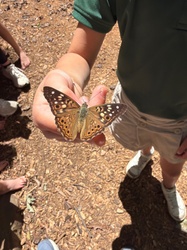
The Hackberry Emperor (Asterocampa celtis) is a medium-sized butterfly with a wingspan of about 1.8 to 2.5 inches, colored to blend with bark and dappled shade.
- Upperside is tan to grayish-brown with darker brown markings and a cluster of small white spots near the tip of the forewing
- A single black spot sits within the forewing's discal cell (the central cell area), a key mark that separates it from its close relative the Tawny Emperor
- Hindwing shows a row of small, dark eyespots along the outer margin, each usually with a pale center
- Underside is pale gray-brown, finely mottled, with eyespots repeated and a cryptic, bark-like pattern that provides excellent camouflage on tree trunks
- Antennae are clubbed and the body is stout; the flight is fast and erratic
Where and When to Look
Hackberry Emperors are found wherever hackberry trees (Celtis species) grow, since that is the required host plant, across much of the eastern and central United States. Adults perch on tree trunks, fence posts, and foliage, often at eye level, and rarely visit flowers, instead favoring tree sap, rotting fruit, and damp ground. Look for them along woodland edges, riverbanks, and shaded lanes from late spring through early fall, with multiple broods in warmer regions.
Similar-Looking Species
- Tawny Emperor: very similar overall, but lacks the black spot in the forewing discal cell and lacks the small white apical spots that the Hackberry Emperor shows; its hindwing eyespots are also fainter or absent
- Question Mark and Comma (anglewings): share a bark-like underside but have more ragged, angular wing outlines and a pale comma or question-mark shaped mark underneath
- Satyrs (wood-nymphs, etc.): also have eyespots, but lack the white forewing apical spots and tend to fly in grassy areas rather than perching on tree trunks
Checking the forewing discal cell for a solid black spot, combined with the crisp white apical spots, is the most reliable way to separate this species from the Tawny Emperor.
Quick ID Checklist
- Tan-brown wings with white spots near forewing tip
- Black spot inside the forewing discal cell
- Row of small eyespots along hindwing margin
- Perches on tree trunks and bark rather than flowers
- Always found near hackberry trees
Frequently asked questions
How do I tell a Hackberry Emperor from a Tawny Emperor?
Look at the forewing: the Hackberry Emperor has a solid black spot in the discal cell and small white spots near the wingtip, both of which the Tawny Emperor lacks or shows only faintly.
Why do Hackberry Emperors perch on tree trunks instead of flowers?
This species rarely feeds at flowers, preferring tree sap, rotting fruit, and damp soil, so it is most often seen resting on bark, fence posts, or foliage rather than nectaring.
What tree should I check if I want to find this butterfly?
Search near hackberry trees (Celtis species), which serve as the required host plant and are the best predictor of where adults will be found.
When are Hackberry Emperors active during the year?
Adults fly from late spring through early fall, with multiple overlapping broods in warmer parts of their range.
Hackberry Emperor identified by the community
Recent Hackberry Emperor finds identified with Bug Identifier.