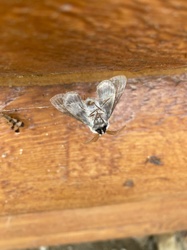
Hummingbird Moth Identification Guide
Learn to distinguish this day-flying moth that hovers at flowers just like a tiny hummingbird.
Read the full Hummingbird Moth encyclopedia entry →Key Visual Features
- Stout, robust body, typically 1.5-2 inches (4-5 cm) long, with a somewhat tapered, spindle-like abdomen often ending in a fan of hair-like scales resembling a small tail.
- Wings are relatively narrow and often partly clear or translucent in the middle, especially in species sometimes called "clearwing" moths, bordered by darker reddish-brown or olive scales.
- Body coloring commonly includes olive-green, burgundy, or reddish-brown tones on the thorax and abdomen, sometimes with lighter banding.
- A long, coiled proboscis (feeding tube) is often visible extended forward while feeding, sometimes appearing as long as or longer than the body.
- Wings beat extremely fast, creating an audible hum and enabling the moth to hover in place in front of flowers, much like a hummingbird.
- Antennae are thickened and club-shaped near the tips, unlike the feathery antennae of many other moths.
Where and When You'd See It
- Found in gardens, meadows, and woodland edges with abundant nectar-producing flowers.
- Unlike most moths, this species is active during the day, especially in bright sunlight, and also sometimes at dusk.
- Most commonly seen from late spring through summer, hovering at tubular flowers while feeding.
- Rarely seen at rest with wings spread; more often observed in constant hovering flight near blossoms.
Similar-Looking Species
- Bumblebees can create a similar hovering buzz near flowers, but lack wings and a long proboscis, and have a rounder, fuzzier body without the moth's tapered abdomen and tail-like scale fan.
- True hummingbirds are much larger, have feathers and a rigid beak rather than a coiled proboscis, and lack the visible antennae of an insect.
- Other day-flying moths and sphinx moths can share a similar hovering behavior, but the combination of small size, partly clear wings, and tail-fan scales is most typical of the hummingbird moth specifically.
Quick ID Checklist
- Stout body about 1.5-2 inches long with a tapered abdomen and tail-like scale fan.
- Wings partly clear or translucent, bordered with reddish-brown or olive scales.
- Long, visible coiled proboscis extended while feeding.
- Fast wingbeats producing an audible hum and hovering flight at flowers.
- Active during the day, unlike most other moths.
Frequently asked questions
How can I tell a hummingbird moth from an actual hummingbird?
The moth is much smaller, has visible insect antennae, a coiled proboscis rather than a rigid beak, and wings instead of feathers, even though both hover in a similar way while feeding at flowers.
Why are the wings partly see-through on some individuals?
Certain hummingbird moth species lose the colored scales from the center of their wings shortly after emerging, leaving a clear or translucent patch bordered by darker scales, which is a helpful identification feature.
Is it unusual for a moth to fly during the day?
Yes, most moths are nocturnal, so encountering a moth actively hovering at flowers in bright daylight is itself a strong clue that you may be looking at a hummingbird moth or a related day-flying species.
How do I tell it apart from a bumblebee hovering at the same flower?
Look for the moth's tapered abdomen ending in a tail-like fan of scales, its long coiled proboscis, and its distinct antennae, all of which a rounder, fuzzier bumblebee lacks.
Hummingbird Moth identified by the community
Recent Hummingbird Moth finds identified with Bug Identifier.