Longhorn Bee Identification Guide
Spot longhorn bees by the males' remarkably long antennae and their strong association with late-summer sunflowers and asters.
Read the full Longhorn Bee encyclopedia entry →Key Visual Features
Longhorn bees (genera Melissodes and Eucera) are robust, fuzzy solitary bees named for a striking feature in the males:
- Medium size, roughly 10-16mm
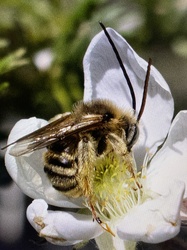
- Fuzzy tan, brown, or gray hair covering the thorax, often paired with a darker abdomen showing pale hair bands
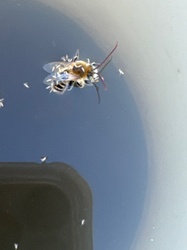
- Males have dramatically elongated antennae, in some species longer than the entire body — the single best field clue for this group
- Females have shorter antennae but carry dense pollen-collecting hairs (scopa) on their hind legs
- Overall build is stocky and well-furred, similar in bulk to a small bumble bee
Where and When You'll See Them
Longhorn bees are strongly associated with composite flowers such as sunflowers and asters, and they're commonly found in open fields, meadows, and gardens where these plants bloom. Females nest solitarily in bare ground. Activity peaks in mid-to-late summer, later in the season than many other solitary bee groups, which is itself a helpful timing clue alongside the antennae length.
Similar-Looking Bugs
- Bumble bees are rounder overall and have much shorter antennae than male longhorn bees.
- Digger bees share a similar general build and size but lack the extremely long antennae of longhorn bee males and aren't as tightly tied to composite flowers.
- When antennae length isn't a clear giveaway (as in females), late-summer timing and a preference for sunflower-family blooms help narrow the identification.
Quick ID Checklist
- Fuzzy, stocky body, 10-16mm, pale hair bands on the abdomen
- Males have exceptionally long antennae, sometimes exceeding body length
- Strong association with sunflowers, asters, and other composite flowers
- Females nest solitarily in bare ground
- Most active mid-to-late summer
Frequently asked questions
Why are they called longhorn bees?
Males have remarkably long antennae, in some species longer than the bee's entire body, which is the source of the common name.
What flowers do longhorn bees prefer?
They show a strong preference for composite flowers such as sunflowers and asters, and are commonly found wherever these plants are blooming.
How can I identify a female longhorn bee without the long antennae?
Look at timing and habitat — females appear in mid-to-late summer around sunflower-family blooms, and have a fuzzy, stocky build with pale abdominal hair bands.
When are longhorn bees most active?
They peak in mid-to-late summer, later in the season than many other solitary bee groups.
Longhorn Bee identified by the community
Recent Longhorn Bee finds identified with Bug Identifier.