Migratory Locust Identification Guide
Identify this wide-ranging swarming grasshopper by its saddle-shaped pronotum and phase-dependent coloring.
Read the full Migratory Locust encyclopedia entry →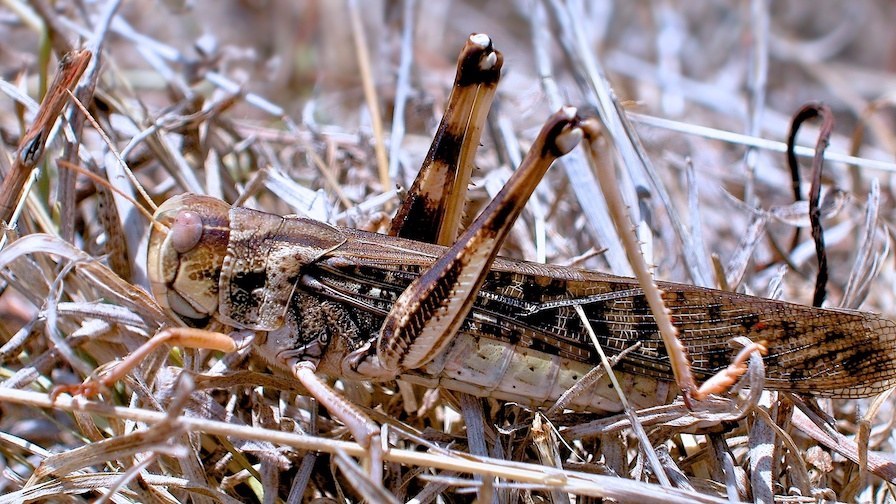
Key Visual Features
The migratory locust (Locusta migratoria) is a large, robust grasshopper, generally 1.5 to 2.5 inches long, with females larger than males.
- Body shape: Thick-bodied with a distinctive saddle-shaped pronotum (the shield-like plate behind the head) that curves downward toward the back.
- Legs: Muscular hind legs adapted for jumping, paired with narrower front and middle legs.
- Wings: Long, narrow forewings and wide hindwings extending past the abdomen tip, enabling strong sustained flight.
- Color and phases: Coloring depends on population density. Solitary individuals are typically green or brown, matching surrounding grasses. Gregarious, swarm-phase individuals turn a yellowish-brown with contrasting black or dark mottled markings, especially on the wings and body.
- Head and antennae: Rounded head with large eyes and short, stout antennae.
Where and When You'll See It
Migratory locusts have one of the widest ranges of any locust species, found across Africa, Asia, Australia, and parts of Europe in grasslands, floodplains, and agricultural margins. Solitary individuals are scattered and easily overlooked among grasses. Under favorable breeding conditions, populations can build up and shift into the gregarious phase, forming large day-flying swarms that move seasonally in search of food.
Similar-Looking Species
- Desert locust: Found in more arid regions of Africa, the Middle East, and southwestern Asia; its gregarious adults tend to appear more uniformly yellow rather than showing the strong dark chevron-like mottling typical of migratory locust swarms.
- Other large grassland grasshoppers: Species such as differential or American grasshoppers are similarly sized but do not exhibit the same density-dependent color change or large-scale swarming behavior.
- Regional short-horned grasshoppers: Usually lack the pronounced saddle-shaped pronotum and do not form true migratory swarms.
Quick ID Checklist
- Saddle-shaped pronotum curving down the back
- Solitary phase: green or brown, blending with grass
- Gregarious phase: yellow-brown body with black mottled markings
- Long wings extending past the abdomen for strong flight
- Found in grasslands and floodplains across Africa, Asia, Australia, and Europe, often in seasonal swarms
Frequently asked questions
What does a migratory locust look like?
It's a large, thick-bodied grasshopper with a saddle-shaped plate behind its head; its color ranges from green or brown when solitary to yellow-brown with black mottling when part of a swarm.
How is the migratory locust different from the desert locust?
The two overlap in range in parts of Africa and Asia, but the migratory locust's swarming adults show more contrasting dark mottled markings, while desert locust swarming adults appear more uniformly yellow, and the desert locust favors more arid habitats.
Where do migratory locusts live?
They are found in grasslands, floodplains, and farmland margins across a very wide range spanning Africa, Asia, Australia, and parts of Europe.
Do migratory locusts always look the same?
No, their appearance changes with population density — scattered individuals are camouflage-colored, while crowded swarming groups develop brighter, more contrasting coloring.
Migratory Locust identified by the community
Recent Migratory Locust finds identified with Bug Identifier.