Milkweed Tussock Caterpillar Identification Guide
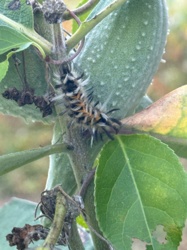
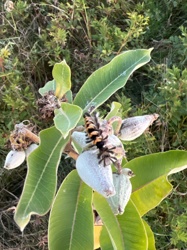
Tell apart this tufted, tricolor caterpillar found exclusively on milkweed by its rows of black, white, and orange hair pencils.
Read the full Milkweed Tussock Caterpillar encyclopedia entry →
Key Visual Features
The milkweed tussock caterpillar (sometimes called the milkweed tiger moth caterpillar) is a distinctively fuzzy, multicolored larva found only on milkweed plants.
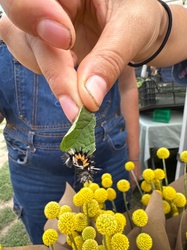
- Body color: Covered in dense tufts of hair in three colors — black, gray-white, and orange — arranged in bands and rows along the length of the body.
- Hair tufts: Unlike a uniform hair coat, the setae form distinct pencil-like tufts, with orange tufts often concentrated toward the front and rear and black/white tufts alternating along the middle of the body.
- Body shape: Cylindrical and moderately plump, typically reaching about 1-1.5 inches at maturity.
- Head: Small and dark, mostly hidden beneath the surrounding hair tufts.
- Legs: True legs and prolegs are present but largely obscured by the dense hair.
Where and When You'll See It
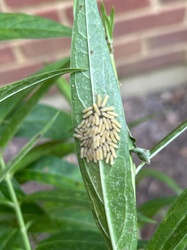
Milkweed tussock caterpillars feed exclusively on milkweed species, making the host plant itself one of the best identification clues. They occur across much of the United States and southern Canada. Young larvae are gregarious, often found feeding together in clusters on a single leaf, while older larvae disperse and feed individually. They are most commonly seen from mid to late summer.
Similar-Looking Caterpillars
- Monarch caterpillar: Also feeds exclusively on milkweed but looks completely different — smooth-bodied with bold yellow, black, and white bands and no hair tufts.
- Other tussock moth caterpillars: Many tussock species have tufted hair, but the milkweed tussock's specific black-white-orange combination combined with its exclusive milkweed diet makes it distinctive.
- Woolly bear caterpillars: Have a more uniform, evenly distributed hair coat (often banded black and orange/brown) rather than the tufted, pencil-like clusters of the milkweed tussock, and are not restricted to milkweed.
Quick ID Checklist
- Dense tufts of black, gray-white, and orange hair arranged along the body
- Found feeding exclusively on milkweed plants
- Young larvae often clustered together on a single leaf
- Cylindrical body about 1-1.5 inches long at maturity
- Distinct from the smooth-bodied, banded monarch caterpillar sharing the same host plant
Frequently asked questions
How is the milkweed tussock caterpillar different from a monarch caterpillar?
Both feed on milkweed, but the monarch caterpillar is smooth-bodied with bold yellow, black, and white bands, while the milkweed tussock caterpillar is covered in tufted black, white, and orange hair.
Why are young milkweed tussock caterpillars often found in groups?
Early instars are gregarious and feed together on the same leaf before dispersing to feed individually as they mature.
What plant should I check if I suspect a milkweed tussock caterpillar?
Check milkweed species specifically, as this caterpillar feeds almost exclusively on plants in that group.
What does the adult moth look like?
The adult is known as the milkweed tiger moth, a moth with mostly gray wings and a yellow-orange abdomen marked with black spots.
Milkweed Tussock Caterpillar identified by the community
Recent Milkweed Tussock Caterpillar finds identified with Bug Identifier.