Mourning Cloak Caterpillar Identification Guide
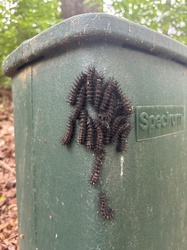
A black, spiny caterpillar speckled with white dots and a row of red-orange spots down its back, often found feeding in groups.
Read the full Mourning Cloak Caterpillar encyclopedia entry →Key Visual Features
The mourning cloak caterpillar reaches about 2 inches long and has a bold, easily recognized pattern.
- Color: Deep black body covered in fine white speckling that gives it a dusted or starry appearance
- Back markings: A row of red-orange spots runs down the center of the back, spaced evenly along the length of the body
- Spines: Rows of long, branching black spines cover the back and sides
- Head: Black, often with fine speckling matching the body
- Body shape: Thick and cylindrical, with the spine rows and back spots being the most prominent identifying features
Where and When You'll See It
Mourning cloak caterpillars feed on the leaves of willow, elm, hackberry, poplar, and related trees. A key behavioral clue is that they feed together in groups, especially in earlier stages, often stripping a branch of leaves communally before dispersing as they near maturity. They are most visible from spring into early summer, resting in clusters on defoliated branches or moving along bark and twigs when searching for new feeding sites or shelter to pupate.
Similar-Looking Bugs
- Question mark caterpillar: Also dark and spiny, but generally lacks the consistent row of red-orange back spots and the fine white speckling seen on mourning cloak caterpillars, and is usually found alone rather than in groups
- Red admiral caterpillar: Spiny and dark but typically shows pale side markings rather than a distinct row of red-orange back spots, and feeds on nettle rather than willow or elm
- Buckeye caterpillar: Dark and spiny with blue-based spines and orange head markings, but found on plantain and snapdragon-family plants rather than trees
Quick ID Checklist
- Black body with fine white speckling
- Row of red-orange spots down the center of the back
- Long, branching black spines
- Found feeding in groups on willow, elm, hackberry, or poplar
- Most visible from spring into early summer
Frequently asked questions
What is the easiest way to identify a mourning cloak caterpillar?
Look for a black, spiny caterpillar with fine white speckling and a row of red-orange spots running down the center of its back.
Do mourning cloak caterpillars feed alone or in groups?
They typically feed together in groups, especially in the earlier stages, often stripping a branch of leaves communally before spreading out as they mature.
What trees do mourning cloak caterpillars feed on?
They commonly feed on willow, elm, hackberry, and poplar leaves.
How is the mourning cloak caterpillar different from the question mark caterpillar?
The mourning cloak caterpillar has a consistent row of red-orange spots down its back along with fine white speckling and feeds in groups, while the question mark caterpillar lacks the regular spot row and is usually found alone.
Mourning Cloak Caterpillar identified by the community
Recent Mourning Cloak Caterpillar finds identified with Bug Identifier.