Orange Tip Identification Guide
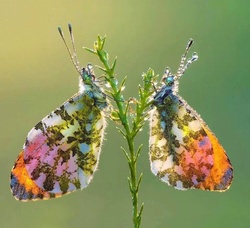
Learn to spot the male's fiery orange wingtips and the marbled green camouflage both sexes share.
Read the full Orange Tip encyclopedia entry →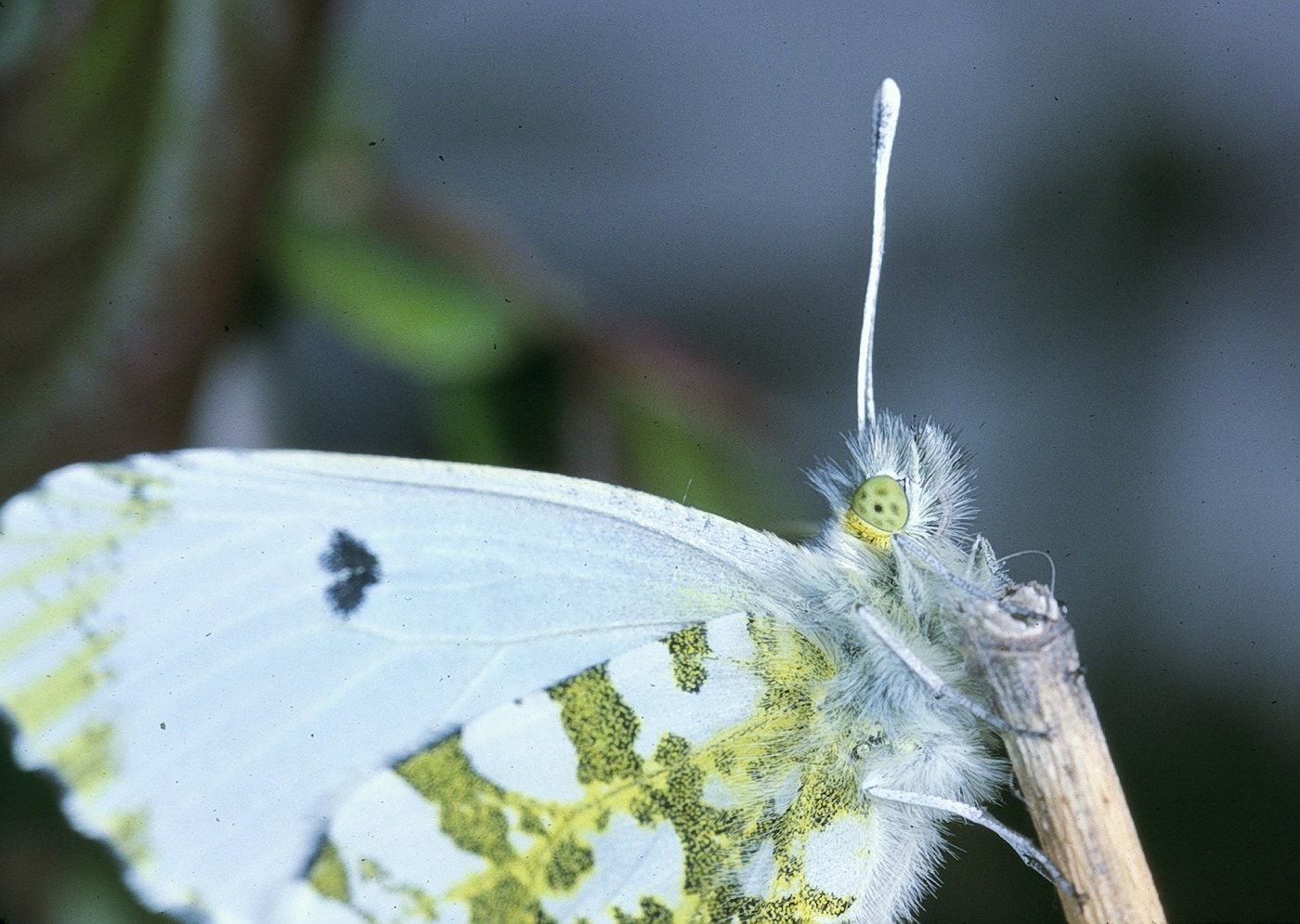
Key Features
- Small-to-medium butterfly, wingspan around 4–5 cm (1.6–2 inches)
- Males show a bright orange-tipped patch on the outer half of each forewing, bordered by a band of black scaling that separates the orange from the white base color
- Females lack the orange patch entirely; forewing tips are dark gray-black instead, which can make them look like a plainer white butterfly at a distance
- Both sexes share a mottled moss-green-and-white marbled pattern on the underside of the hindwings, which provides camouflage among flowers and leaves when the wings are folded shut
- Rounded wing shape, white or pale cream ground color on the upper wings
- Slender black body and thread-like antennae with small clubbed tips
- Small black spot near the center of each forewing on the upperside, present in both sexes
Where & When to Spot One
- Common across meadows, hedgerows, woodland edges, damp grassy verges, riverbanks, and gardens in temperate Europe and parts of Asia
- Single generation per year in most regions, flying from early spring through early summer (roughly April to June)
- Most active on sunny mornings and afternoons, often seen fluttering low and steadily over wildflowers such as cuckooflower and garlic mustard, which also serve as the main caterpillar host plants
- Frequently rests with wings closed, showing only the marbled green underside, and will bask with wings angled toward the sun to warm up on cool mornings
- Eggs are laid singly on flower buds, and the caterpillars that follow are pale green and well camouflaged among developing seed pods
Similar Species
- Small White and Green-veined White: both lack the orange wingtip and have a plainer, more uniformly pale underside without the marbled green pattern
- Female Orange Tips are easily confused with other white butterflies at a glance — check for the marbled green-and-white underside when the wings are closed, which is unique to this species
- Males are essentially unmistakable once the orange tip is visible in flight or at rest, since no other common white butterfly in the region shows this coloring
- Wood White has a much more delicate, weak flight and narrower wings, with no orange or green marbling at all
Quick ID Checklist
- Orange patch on forewing tips (males only)
- Marbled green-and-white pattern on hindwing underside (both sexes)
- Small-to-medium size with rounded wings
- Seen in spring, low over meadow flowers
- Rests with wings folded, showing camouflage pattern
Frequently asked questions
How can I tell a male from a female Orange Tip?
Males have distinct orange tips on their forewings, while females have plain dark gray-black tips with no orange.
Why does my Orange Tip sighting look plain white?
You've likely spotted a female, which lacks the orange patch — look for the marbled green underside pattern to confirm the species.
What time of year are Orange Tips active?
They fly for a single generation each year, typically from early spring into early summer.
Where is the best place to look for Orange Tips?
Sunny meadows, hedgerows, and damp grassy areas with wildflowers like cuckooflower are prime spots.
Orange Tip identified by the community
Recent Orange Tip finds identified with Bug Identifier.