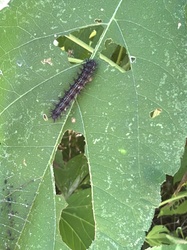
Question Mark Caterpillar Identification Guide
A spiny caterpillar with a variable dark to reddish body, found on elm, hackberry, and nettle leaves.
Read the full Question Mark Caterpillar encyclopedia entry →Key Visual Features
The question mark caterpillar grows to roughly 1.5 inches long and shows considerable variation in color between individuals.
- Color: Ranges from black to dark reddish-orange, sometimes with a mix of both tones on the same individual
- Spines: Covered in rows of branching spines running down the back and sides, often black or dark orange to match or contrast with the body color
- Markings: Fine white or pale speckling can appear along the body in some individuals, adding to the mottled look
- Head: Small, often bearing a pair of short, branched projections that add to the spiny appearance near the front of the body
- Body shape: Cylindrical and moderately stout, with the spine rows the most prominent visual feature
Where and When You'll See It
Question mark caterpillars feed on elm, hackberry, and nettle plants, among other related host plants. They are typically found from spring through fall, with multiple generations possible depending on region and climate. Look for them resting on the undersides of leaves on host trees and plants, where their dark, spiny form can be mistaken at a glance for debris or a small twig fragment rather than a caterpillar.
Similar-Looking Bugs
- Mourning cloak caterpillar: Also dark and spiny, but has a row of distinct red-orange spots down its back and small white speckling covering the body, plus feeds in groups rather than alone
- Eastern comma caterpillar: Very similar in appearance and host plant preference (elm, hackberry, nettle), with color and spine pattern being the main distinguishing features, though the two can be difficult to separate without close inspection
- Red admiral caterpillar: Also spiny and found on nettle, but typically shows a more uniform dark body with pale side markings and constructs a folded-leaf shelter
Quick ID Checklist
- Dark to reddish-orange body, highly variable in color
- Rows of branching black or dark orange spines
- Small, branched head projections
- Found on elm, hackberry, or nettle leaves
- Present from spring through fall, often resting under leaves
Frequently asked questions
Why does the question mark caterpillar vary so much in color?
Individual coloring can range from black to dark reddish-orange, and this natural variation is normal for the species, so spine pattern and host plant are more consistent identification clues than color alone.
What plants do question mark caterpillars feed on?
They feed on elm, hackberry, and nettle plants.
How can I tell a question mark caterpillar from a mourning cloak caterpillar?
The mourning cloak caterpillar has a distinct row of red-orange spots down its back along with fine white speckling and feeds in groups, while the question mark caterpillar lacks the consistent spot row and is more often found alone.
Where on the plant do question mark caterpillars rest?
They are commonly found resting on the undersides of leaves on their host trees and plants, where their dark, spiny shape can blend in with debris or twig fragments.
Question Mark Caterpillar identified by the community
Recent Question Mark Caterpillar finds identified with Bug Identifier.