Snakefly Identification Guide
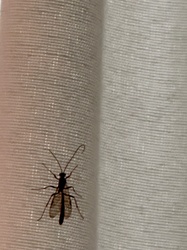
Spot this slender insect by its long snake-like neck and, in females, a needle-thin tail spike.
Read the full Snakefly encyclopedia entry →Key Visual Features
Snakeflies get their name from an elongated, flexible prothorax (the segment behind the head) that lets them raise and swivel the front of the body in a snake-like manner. Look for:
- A body length of about 0.4 to 0.8 inches, slender and elongated overall
- A noticeably long, narrow prothorax that separates the head from the wings, giving a "periscope neck" look
- A small head with strong chewing mouthparts and large eyes
- Two pairs of clear, membranous wings with dense netted veins, held tent-like over the back at rest
- In females, a long, thin, thread-like ovipositor extending from the tip of the abdomen that can appear as long as the body itself
- Coloring generally brown or blackish, sometimes with amber-tinted wings
Where and When You'd See It
Snakeflies are associated with wooded and forested habitats, especially areas with conifers or old bark, loose wood, and leaf litter. They are most active in spring and early summer. Look for them resting on tree trunks, fence posts, or foliage, often moving slowly and raising the front part of the body when disturbed — the behavior that inspired their name. They tend to stay low on trunks or branches rather than flying far, and are more often walked up on than seen in flight.
Similar-Looking Bugs
- Mantidflies also have an elongated front section but pair it with enlarged, grasping front legs, which snakeflies lack — a snakefly's legs are all ordinary walking legs.
- Lacewings share the netted wing pattern but have a short, compact thorax without the extended "neck."
- Ichneumon wasps (in females) also show a long thin ovipositor, but wasps have a narrow pinched waist and lack the netted four-wing pattern and elongated prothorax.
Quick ID Checklist
- Elongated, flexible neck-like prothorax
- Four clear, netted wings held tent-style over the body
- Ordinary (non-grasping) legs on all three pairs
- Females show a very long, thin ovipositor at the tail end
- Found on tree bark or foliage in forested settings, spring to early summer
Frequently asked questions
What makes the snakefly's neck different from other insects?
Its prothorax is unusually long and flexible, letting the head and front legs lift and turn independently of the rest of the body, unlike the short, fixed thorax section of most insects.
Is the long tail filament on some snakeflies a stinger?
That thin filament is an ovipositor found only on females, used for reaching into bark crevices; it is not a stinger and is simply an egg-laying structure.
How do snakeflies differ from mantidflies at a glance?
Snakeflies have plain walking legs on all three pairs, while mantidflies have enlarged, spined front legs held up like a mantis.
Where is the best place to look for a snakefly?
Check tree bark, fence posts, and foliage in or near wooded areas, particularly around conifers, during spring and early summer.
Snakefly identified by the community
Recent Snakefly finds identified with Bug Identifier.