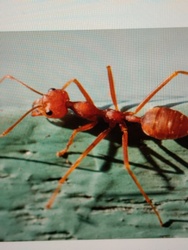
Weaver Ant Identification Guide
Identify Weaver Ants by their bright reddish-orange bodies and distinctive nests woven from living leaves.
Read the full Weaver Ant encyclopedia entry →Key Visual Features
- Medium to large ant, roughly 5-10 mm long, with a slender, long-legged build.
- Coloring is bright reddish-orange to orange-brown across most of the body, sometimes with a slightly darker head or abdomen.
- Body is smooth and largely hairless, with a glossy sheen visible in sunlight.
- Long, thin legs and long, elbowed antennae give the ant an agile, fast-moving appearance as it travels along branches.
- Major workers have a proportionally larger head with strong mandibles used both for defense and for manipulating leaves during nest construction.
Where and When You're Likely to See It
- Found in tropical regions of Asia, Australia, and parts of Africa, inhabiting trees and shrubs in forests, orchards, gardens, and urban green spaces.
- The most identifiable sign of this species is its nest: workers pull living leaves together and bind the edges using silk produced by the colony's own larvae, creating a rounded, tent-like leaf nest high in a tree canopy.
- Multiple leaf nests are often connected within the same tree or between neighboring trees by ant trails running along branches, forming a single large colony network.
- Active during the day, with workers constantly moving along trails on branches, trunks, and leaf surfaces in search of food and nest-building material.
- Most visible in warm, humid tropical climates year-round, with activity slowing only during unusually cool or dry conditions.
Similar-Looking Species
- Carpenter ants can share a reddish tone but are bulkier, nest in wood cavities rather than woven leaves, and lack the same glossy, slender build.
- Sugar ants have similar coloring in some regions but nest in soil or wood rather than constructing leaf nests.
- Fire ants are more uniformly reddish but build soil mounds rather than arboreal leaf nests and are considerably smaller.
- Trap-jaw ants can share a bright coloring but have distinctive straight, spring-loaded mandibles rather than the more typical curved mandibles of weaver ants.
Quick ID Checklist
- Bright reddish-orange, glossy, slender body, 5-10 mm long.
- Long legs and long, elbowed antennae.
- Nest formed from living leaves bound together with silk, high in tree canopy.
- Multiple connected leaf nests within or between trees.
- Active trails running along branches and leaf surfaces in daylight.
Frequently asked questions
How do Weaver Ants build their distinctive nests?
Workers pull living leaves together and bind the edges using silk produced by the colony's larvae, forming a rounded, tent-like nest in the tree canopy.
Where in the world are Weaver Ants typically found?
They are native to tropical regions of Asia, Australia, and parts of Africa, living in trees and shrubs in forests, gardens, and orchards.
How can I tell a Weaver Ant from a Sugar Ant?
Both can show reddish-orange coloring, but weaver ants build distinctive woven leaf nests in trees, while sugar ants typically nest in soil, wood, or under debris.
Why do Weaver Ant trails sometimes span multiple trees?
A single colony can maintain several connected leaf nests within one tree or across neighboring trees, linked by ongoing worker trails along branches.
Weaver Ant identified by the community
Recent Weaver Ant finds identified with Bug Identifier.