Ant Identification Guide
Learn how to tell ants apart from look-alikes using their pinched waist, elbowed antennae, and social nesting habits.
Read the full Ant encyclopedia entry →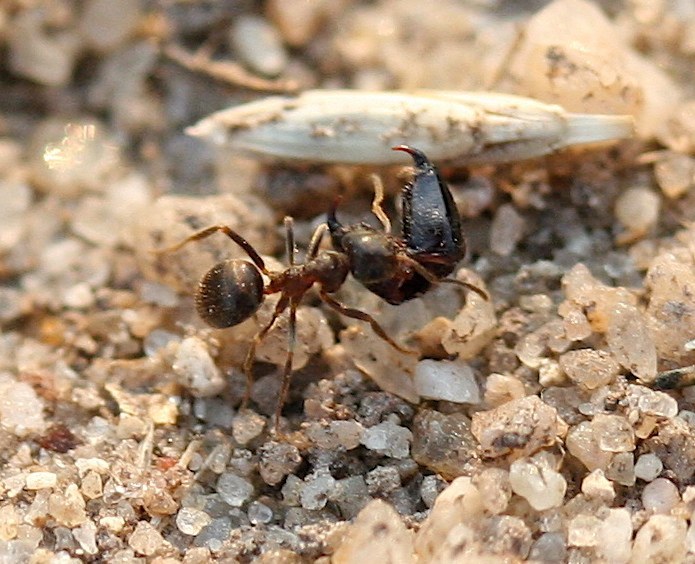
Key Visual Features
Ants are small, social insects with a body clearly divided into three sections: a head, a thorax, and an abdomen, connected by a narrow, pinched "waist" called a petiole. This narrow waist is the single most reliable feature separating ants from similar insects.
- Size: Most household and garden ants range from 1/8 to 1/2 inch long, though queens and some tropical species can be larger.
- Color: Ranges widely by species — black, brown, red, reddish-brown, or bicolored (dark head/abdomen with a lighter thorax).
- Antennae: Distinctly "elbowed" or bent at an angle partway along their length, unlike the straight antennae of many other insects.
- Waist: One or two small bump-like segments (nodes) between the thorax and abdomen — visible with a close look or hand lens.
- Wings: Worker ants are wingless. Only reproductive males and future queens grow wings, and only during brief mating swarms.
- Legs: Six legs, attached to the thorax, giving ants a fast, scurrying gait.
Where and When You'll See Them
Ants are found nearly everywhere except polar regions, nesting in soil, under rocks and logs, inside wood, or within wall voids and foundations of buildings. They are most active in warm months, foraging along visible trails between their nest and food or water sources. Activity often peaks in spring and summer, with some species most visible after rain when nests flood.
Similar-Looking Insects
- Termites: Often confused with ants during swarming season, but termites have a thick, uniform waist (no pinch), straight beadlike antennae, and two pairs of wings of equal length (ant wings are unequal in size).
- Winged ants vs. flying insects: Winged reproductive ants can resemble small wasps, but ants lack the wasp's slender, smooth waist constriction combined with a robust thorax, and ant wings fold flat rather than staying rigid.
- Velvet ants: Actually wingless wasps, not true ants — they are fuzzier and typically solitary rather than trail-forming.
Quick ID Checklist
- Narrow, pinched waist with one or two node segments
- Elbowed (bent) antennae
- Three-part body: head, thorax, abdomen
- Workers wingless; only swarmers have unequal wing pairs
- Found in trails, moving between a nest and a food source
Frequently asked questions
How can I tell an ant from a termite?
Look at the waist and antennae: ants have a narrow, pinched waist and bent antennae, while termites have a thick, straight-sided waist and straight antennae. Termite wings are also equal in size, while ant wings are not.
Do all ants have wings?
No. Only reproductive males and virgin queens grow wings, and only briefly during mating swarms. The worker ants you typically see foraging are always wingless.
Why do ants travel in lines?
Worker ants lay down chemical scent trails as they move between the nest and a food source, and other workers follow that trail, creating the visible lines of ants people commonly notice.
What colors can ants be?
Ant coloring varies by species and includes black, brown, reddish-brown, yellow, and bicolored patterns, so color alone is not a reliable way to identify an ant species.
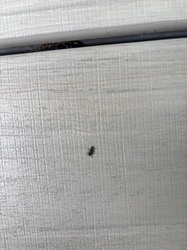
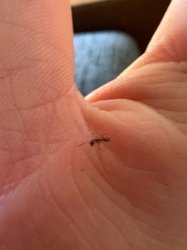
Ant identified by the community
Recent Ant finds identified with Bug Identifier.