Bee Fly Identification Guide
Learn to distinguish this fuzzy, hovering fly from a real bee by its single pair of wings, long rigid proboscis, and darting flight.
Read the full Bee Fly encyclopedia entry →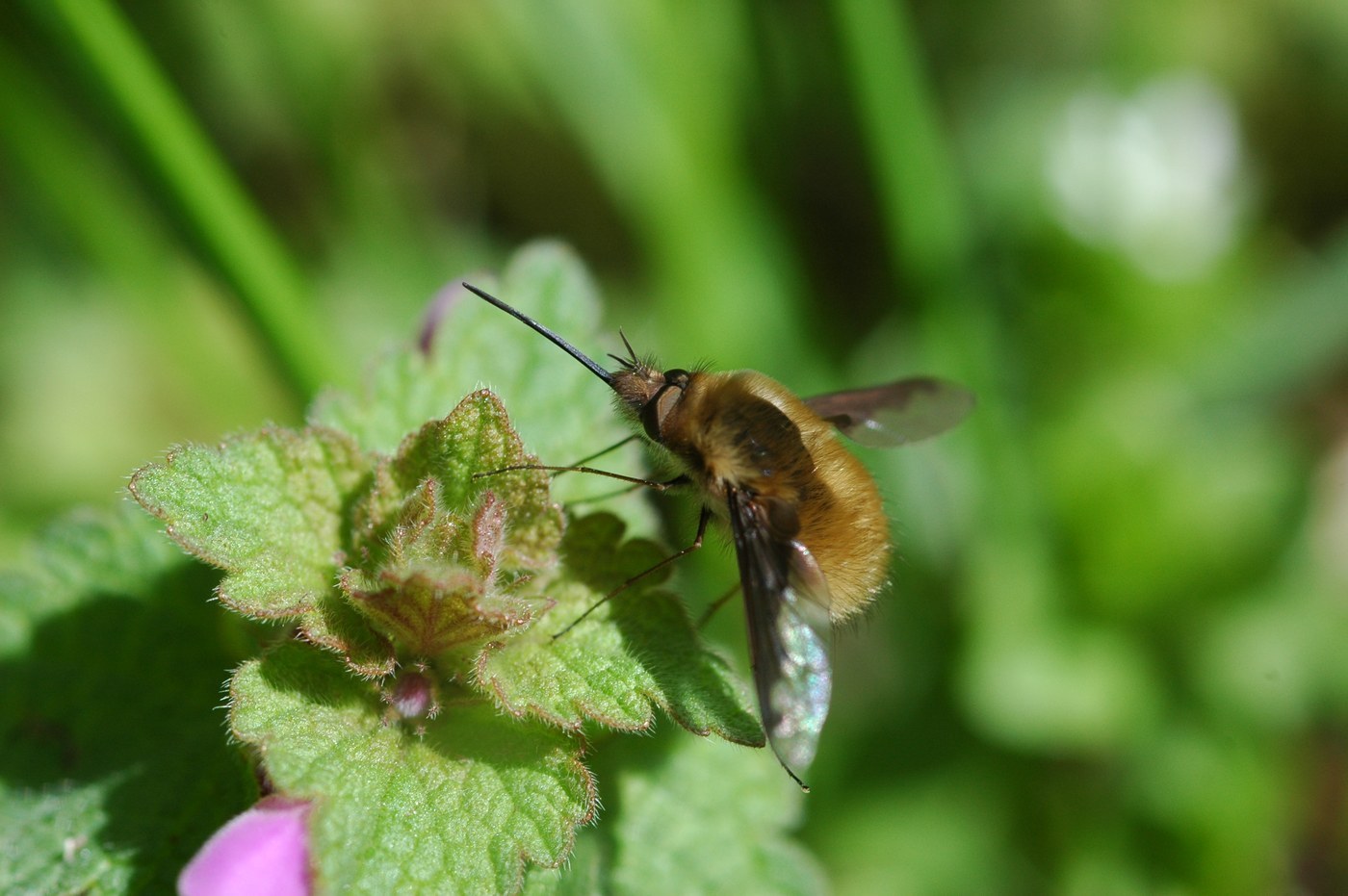
Key Visual Features
Bee flies are furry, bee-mimicking flies that hover with remarkable precision near flowers, often mistaken at a glance for small bees.
- Size: Most common species are small to medium, roughly 0.3 to 0.6 inches (8-15 mm) long.
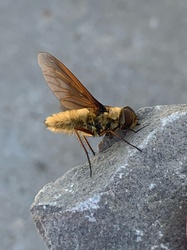
- Color: Densely covered in fuzzy hair, typically tan, gold, brown, or black, sometimes with patterned wings showing dark bands or smoky patches near the leading edge.
- Body shape: Rounded, plump body covered in soft fur, giving a distinctly bee-like or bumblebee-like silhouette.
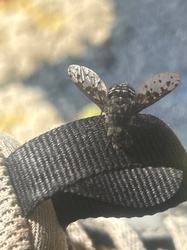
- Wings: A single pair of wings (a key fly trait), often held out to the sides at rest rather than folded over the back; many species show a dark leading-edge band or mottled pattern.
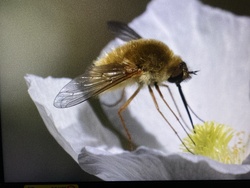
- Legs: Long, thin legs, often held dangling below the body during its characteristic hovering flight.
- Antennae: Short and inconspicuous, unlike the longer antennae of true bees.
- Proboscis: A long, rigid, forward-projecting proboscis extends from the front of the head like a thin needle or straw, used for nectar feeding without landing.
Where and When You'd See One
Bee flies are most often seen in spring, hovering with pinpoint precision in front of flowers in gardens, meadows, and woodland edges, or basking on bare sunny ground and paths. Adults dart quickly between hover points, feeding on nectar without landing, and are especially active on warm, sunny days from early to mid-spring, when many species time their flight to overlap with ground-nesting bee activity (since bee fly larvae are often parasitic on solitary bee nests).
Similar-Looking Bugs
- True bees (especially bumblebees): Have two pairs of wings (though hard to see in flight), longer elbowed antennae, and pollen baskets on the hind legs; bee flies have only one pair of wings and no pollen-carrying structures.
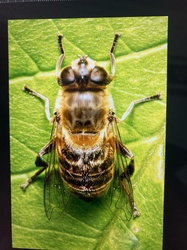
- Hover flies (Syrphidae): Also fly-mimics of bees/wasps, but typically less furry, more slender, and often boldly striped in yellow and black rather than uniformly fuzzy tan or brown.
- Robber flies: Larger, more predatory-looking with a bearded face and stouter build, and they perch to ambush prey rather than hovering delicately at flowers.
- Moths (day-flying): Some furry moths can superficially resemble bee flies but have scaled wings and coiled or absent proboscis rather than a rigid needle-like one.
Quick ID Checklist
- One pair of wings, often held out to the sides at rest
- Long, thin, rigid proboscis projecting forward from the head
- Rounded, densely furry body resembling a small bee
- Hovers with precise, stationary flight in front of flowers
- Long dangling legs visible during hovering flight
Frequently asked questions
How can I tell a bee fly from an actual bee?
Count the wings if possible — bee flies have only one pair of wings like all true flies, while bees have two pairs, and bee flies also have a long rigid proboscis that projects forward rather than a bee's shorter mouthparts.
What is that long needle-like part sticking out of its head?
That is the bee fly's proboscis, a rigid, forward-pointing feeding tube used to sip nectar from flowers while hovering, without the fly needing to land.
When are bee flies most commonly seen?
They are most abundant in early to mid-spring, often seen hovering near flowers or basking on sunny bare ground and paths on warm days.
What is distinctive about how a bee fly flies?
Bee flies hover with remarkable precision, holding a fixed position in the air in front of a flower before darting quickly to another spot, a flight style more controlled and stationary than most bees.
Bee Fly identified by the community
Recent Bee Fly finds identified with Bug Identifier.