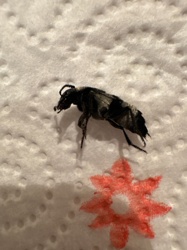
Burying Beetle Identification Guide
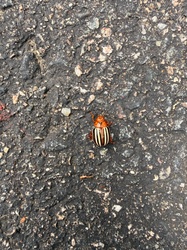
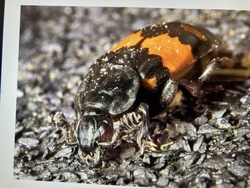
Identify this glossy black beetle by its bold orange bands and distinctive orange-tipped clubbed antennae.
Read the full Burying Beetle encyclopedia entry →Key Visual Features
Burying beetles (genus Nicrophorus) are striking members of the carrion beetle family, known for their bold coloring:
- Size: A robust, elongated-oval body ranging from about 0.5-1.4 inches (12-35mm) long depending on species.
- Coloring: A glossy black body marked with distinctive orange or reddish-orange bands, blotches, or patches across the elytra, with the exact pattern varying by species.
- Antennae: Short, clubbed antennae tipped with a noticeably orange segment, one of the most reliable identifying features across the genus.
- Body shape: Broad and somewhat flattened, with a smooth, glossy shell.
- Legs: Sturdy legs suited for digging in soil.
Where and When You'll See One
Burying beetles are found across forests, grasslands, and meadows in North America, Europe, and Asia depending on the species. Adults are mainly nocturnal and are often drawn to lights at night during the warmer months, from spring through fall. As their name suggests, they are ecologically associated with small carcasses found in their habitat, which factors into their life cycle and behavior in the wild.
Similar-Looking Bugs
- American carrion beetle: A close relative with a flattened body, but shows a pale yellow pronotum with a black center patch and plain black elytra without orange banding, along with dark-tipped rather than orange-tipped antennae.
- Other Nicrophorus species: Very similar to one another; the exact number, shape, and placement of the orange bands or patches on the elytra help distinguish individual species within the genus.
- Click beetles with orange markings: Some species show orange coloring, but have a narrower, more elongated body and a spring-loaded mechanism between the thorax and abdomen that burying beetles lack.
Behavior Notes
Burying beetles have an unusually well-developed sense of smell for locating small carcasses in their habitat, which factors into their nocturnal foraging flights and their tendency to appear suddenly at outdoor lights after dark. Some species show parental behavior uncommon among beetles, with adults remaining near a buried resource to tend developing larvae for a period of time.
Quick ID Checklist
- Glossy black body with bold orange or reddish-orange bands or patches
- Short, clubbed antennae with an orange tip
- Broad, somewhat flattened oval body
- Nocturnal, often seen near lights in warmer months
- Found in forest, grassland, and meadow habitats
Frequently asked questions
What is the most distinctive feature for identifying a burying beetle?
Look for the combination of glossy black elytra marked with bold orange or reddish-orange bands, along with short antennae that end in a distinctly orange-tipped club.
How can I tell a burying beetle apart from an American carrion beetle?
Burying beetles show bold orange banding on the elytra and orange-tipped antennae, while the American carrion beetle has plain black elytra, a pale yellow pronotum with a black center patch, and dark-tipped antennae.
When are burying beetles most active?
They are mainly nocturnal, becoming active at night during the warmer months from spring through fall, and are frequently attracted to outdoor lighting.
Do all burying beetle species have the same orange pattern?
No, the exact placement, shape, and extent of the orange bands or patches vary between the different species within the genus, though the overall black-and-orange color scheme is consistent.
Burying Beetle identified by the community
Recent Burying Beetle finds identified with Bug Identifier.