Drywood Termite Identification Guide
Identify drywood termites by their larger swarmers, lack of mud tubes, and distinctive hexagonal fecal pellets.
Read the full Drywood Termite encyclopedia entry →Key Visual Features
Drywood termites are a group of termite species that live entirely within dry wood, without needing contact with soil.
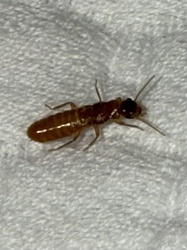
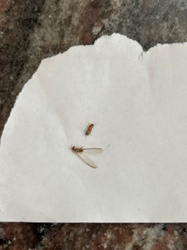
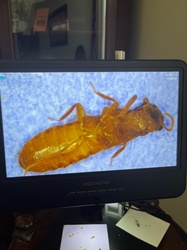
- Swarmers (alates): generally larger and more robust than subterranean termite swarmers, with a body length around 1/2 inch and two pairs of long, translucent to smoky wings.
- Color: swarmers range from reddish-brown to dark brown, with a broader, more cylindrical body than subterranean species.
- Soldiers: have a large, dark, rectangular head with prominent mandibles, often with a pronounced ridge or teeth pattern used to identify the species.
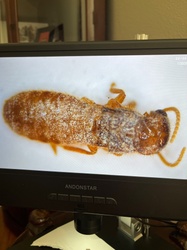
- Body shape: straight waist, no constriction, and straight bead-like antennae, consistent with termites generally.
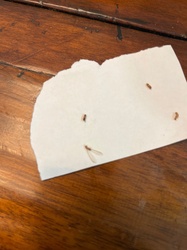
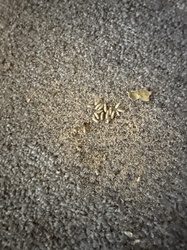
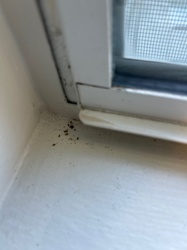
- Frass (droppings): one of the most distinctive identification clues — small, hard, hexagonal, ridged pellets that are pushed out of tiny holes ("kick-out holes") in infested wood and accumulate in small piles.
Where and When You'd See It
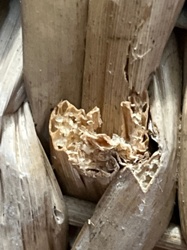
- Colonies are found entirely within sound, dry wood such as structural framing, furniture, and dead tree limbs, with no need for soil contact.
- Swarmers emerge during warm months, often in daylight, and are attracted to light sources.
- Small piles of hexagonal fecal pellets beneath wood surfaces are often the first visible sign, since the termites themselves stay hidden inside wood galleries.
- Common in warmer coastal and inland regions with mild, dry climates.
Similar-Looking Bugs
- Subterranean termite swarmers: generally smaller and require mud tubes to travel between soil and wood, unlike the self-contained drywood colonies.
- Carpenter ant swarmers: have a pinched waist, elbowed antennae, and unequal wing lengths, distinguishing them from the straight-waisted drywood termite.
- Dampwood termite swarmers: typically larger still and associated with moist, decaying wood rather than dry sound wood.
Quick ID Checklist
- Reddish-brown to dark brown swarmers with long translucent wings
- Straight waist and bead-like antennae
- No mud tubes present
- Small hexagonal, ridged fecal pellets near kick-out holes
- Colonies live entirely inside dry wood
Frequently asked questions
What is the easiest sign of a drywood termite infestation to spot?
Small piles of hard, hexagonal, ridged fecal pellets pushed out through tiny kick-out holes in wood are a distinctive identifying sign.
Do drywood termites build mud tubes?
No, unlike subterranean termites, drywood termites live entirely within wood and do not need mud tubes to reach soil.
How do drywood termite swarmers compare in size to subterranean termite swarmers?
Drywood termite swarmers tend to be larger and more robust-bodied than typical subterranean termite swarmers.
What color are drywood termite swarmers?
They range from reddish-brown to dark brown with long translucent to smoky-tinted wings.
Drywood Termite identified by the community
Recent Drywood Termite finds identified with Bug Identifier.