Giant Leopard Moth Identification Guide
Identify this striking tiger moth by its bold black ring-and-spot pattern on brilliant white wings.
Read the full Giant Leopard Moth encyclopedia entry →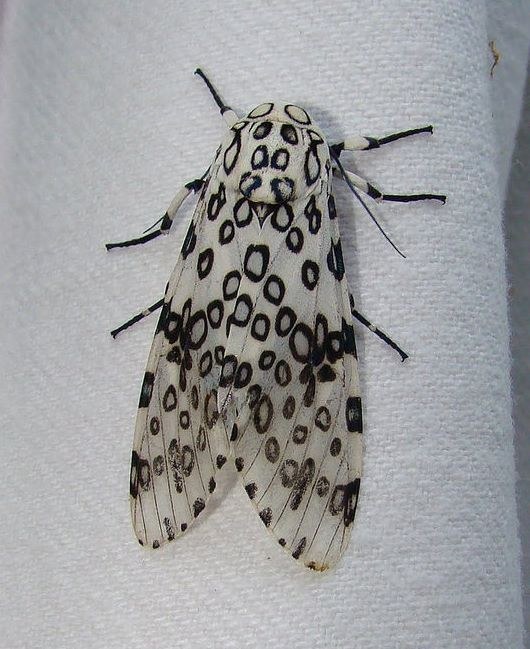
Key Visual Features
The giant leopard moth is one of the most visually striking tiger moths, easily recognized by its bold, high-contrast pattern.
- Size: Large for a tiger moth, with a wingspan of about 2.5-3.5 inches, making it noticeably bigger than most other white-patterned moths in its range.
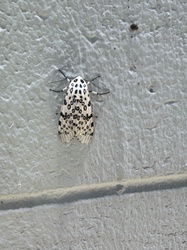
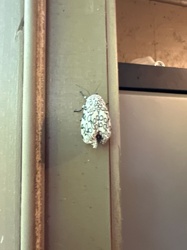
- Color and pattern: Wings are bright white marked with bold black open rings and solid black spots scattered across the forewings, resembling a leopard's or dalmatian's coat. Hindwings are white with dark blue-black spots, generally fewer and smaller than those on the forewings.
- Body shape: Robust, thickly built body with black legs and a somewhat furry thorax.
- Wings: Broad and rounded, held flat or slightly tented at rest, displaying the full spotted pattern.
- Legs and antennae: Legs are black; antennae are thin and thread-like. When the wings are spread or in flight, the abdomen shows an iridescent blue-black sheen with orange-yellow markings between the segments, a feature not visible when the moth is at rest with wings closed.
Where and When You'll See It
This species inhabits wooded areas, meadows, and gardens across eastern and southern North America, favoring habitats with a mix of open ground and shrubby or wooded cover. Its caterpillars, banded black with red between the segments and covered in stiff bristly hairs, are frequently seen crossing paths and roads, especially in cooler months. Adults are nocturnal, flying from late spring through summer, and are commonly drawn to outdoor lights at night, often resting nearby with wings folded by morning.
Similar-Looking Moths
Other tiger moths, such as the harnessed tiger moth, share a general white-and-black patterned look but tend to have more linear or streaked markings rather than the giant leopard moth's bold, circular rings. The giant leopard moth's notably larger size, distinct open-ring spot pattern, and iridescent blue-black abdomen with orange markings make it fairly easy to distinguish once you look closely at the shape and arrangement of the spots.
Quick ID Checklist
- Large moth with bright white wings
- Bold black rings and solid spots in a leopard-like pattern
- Iridescent blue-black abdomen with orange-yellow markings
- Black legs and thread-like antennae
- Nocturnal, frequently attracted to outdoor lights
Frequently asked questions
What is the most distinctive feature of the giant leopard moth?
Its bright white wings covered in bold black open rings and solid spots, resembling a leopard's coat.
Does it have any hidden coloring?
When the wings are spread, the abdomen shows an iridescent blue-black sheen with orange-yellow markings.
How is it different from other tiger moths?
Its larger size and distinct circular, open-ring spot pattern set it apart from similarly patterned tiger moths with more streaked markings.
When and where is it typically seen?
In wooded areas and gardens across eastern and southern North America, mostly at night near outdoor lights.
Giant Leopard Moth identified by the community
Recent Giant Leopard Moth finds identified with Bug Identifier.