Harvester Ant Identification Guide
Identify Harvester Ants by their large reddish-tan bodies and the cleared, seed-strewn mounds around their nests.
Read the full Harvester Ant encyclopedia entry →Key Visual Features
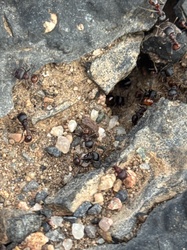
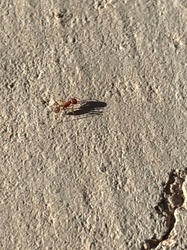
- Relatively large ant, typically 6-10 mm long, with a robust, heavily built body.
- Coloring ranges from reddish-tan or rusty-orange to dark brown or black, depending on the species.
- Head is notably large and broad relative to the body, housing powerful mandibles adapted for crushing and carrying seeds.
- Body is covered in short, coarse hairs, and some species have a fringe of longer hairs beneath the head (a "psammophore") used for moving soil while digging.
- Waist has two nodes, and the abdomen is oval and relatively smooth.
Where and When You're Likely to See It
- Common in arid and semi-arid regions, including deserts, grasslands, and dry open woodlands, particularly across the western and southwestern United States and similar climates elsewhere.
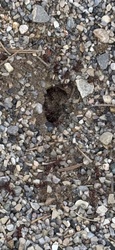
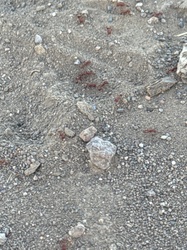
- Nest entrances are highly recognizable: a distinct mound or crater of cleared, bare soil, often several centimeters to over a meter across, kept free of vegetation by the colony.
- Discarded seed husks and plant debris are frequently scattered around the nest entrance, another useful sign of an active colony.
- Foragers are active mainly during the day, especially in the cooler morning and late afternoon hours, retreating underground during the hottest midday period in summer.
- Most active from spring through fall, with activity slowing considerably in cold winter conditions.
Similar-Looking Species
- Carpenter ants are similarly large but usually darker overall and nest in wood rather than forming a cleared soil mound with seed debris.
- Field ants (Formica species) build mounded nests as well but are typically less robust-headed and do not clear vegetation as thoroughly around the entrance.
- Fire ants build looser, fluffy soil mounds without the same distinct bare-earth clearing and seed husk debris.
- Leafcutter ants also build large mounded nests but carry leaf fragments rather than seeds and lack the harvester ant's oversized head.
Quick ID Checklist
- Large (6-10 mm), robust, reddish-tan to dark brown body.
- Oversized head with strong seed-crushing mandibles.
- Two-segmented waist and coarse body hairs.
- Nest marked by a cleared, vegetation-free mound of soil.
- Seed husks and plant debris scattered near the entrance.
Frequently asked questions
How can I recognize a Harvester Ant nest without seeing the ants themselves?
Look for a distinct mound or crater of bare, cleared soil kept free of vegetation, often surrounded by discarded seed husks and plant debris.
Why does the Harvester Ant have such a large head?
Its oversized head houses powerful mandibles adapted for gathering, crushing, and carrying seeds back to the colony.
What time of day are Harvester Ants most active?
They typically forage during the cooler parts of the day, such as morning and late afternoon, and retreat underground during the hottest midday hours in summer.
What habitat is best for finding Harvester Ants?
They favor arid and semi-arid environments such as deserts, grasslands, and dry open woodlands with well-drained soil.
Harvester Ant identified by the community
Recent Harvester Ant finds identified with Bug Identifier.