Itch Mite Identification Guide
Learn the microscopic identifying traits of itch mites, distinguishable only through magnified examination.
Read the full Itch Mite encyclopedia entry →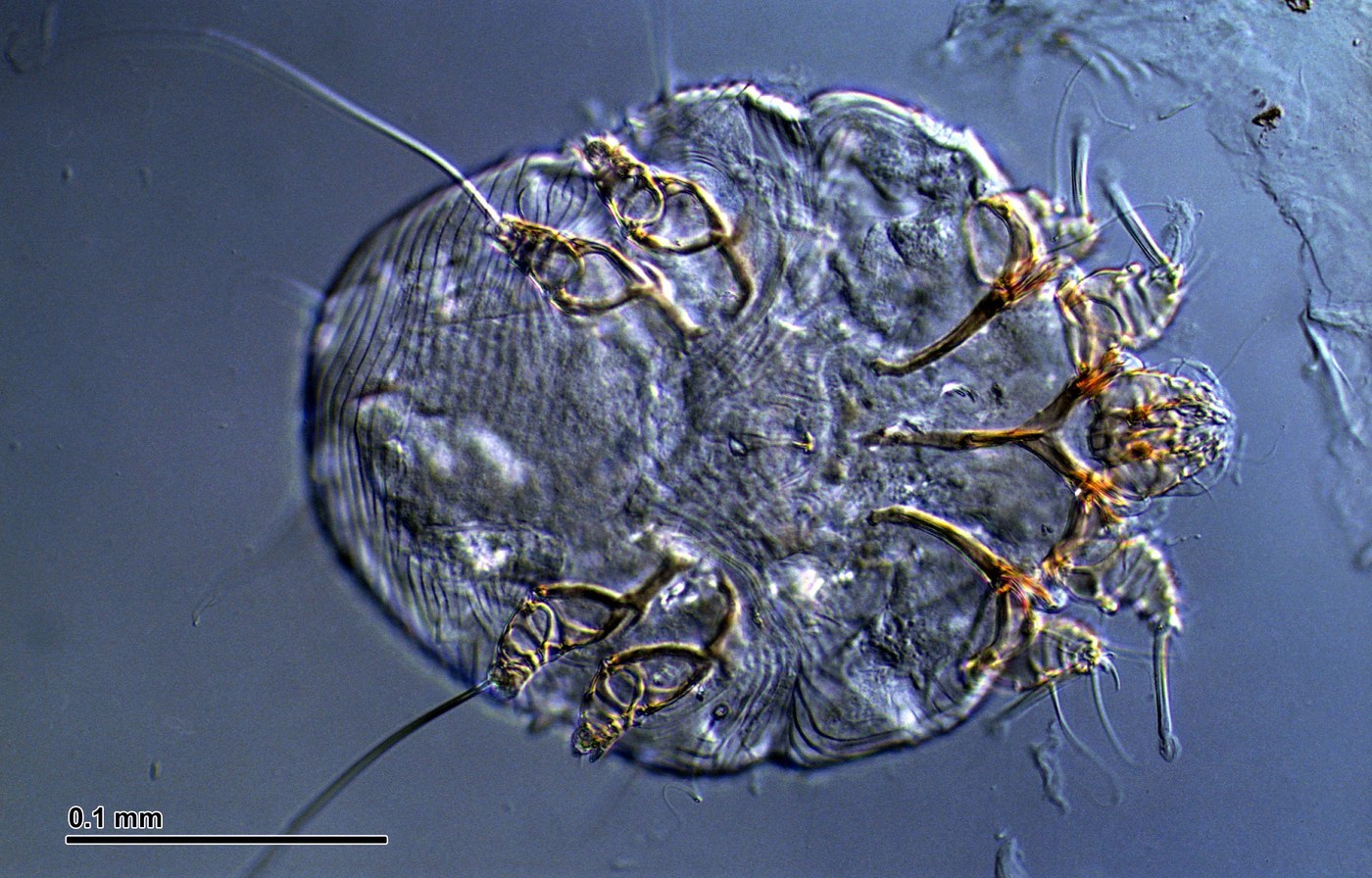
Key Visual Features
Itch mites are extremely small arachnids that, like most mites, can only be properly identified using magnification.
- Size: Roughly 0.2 to 0.4 mm, among the smallest arachnids, invisible to the naked eye.
- Color: Pale whitish to translucent, sometimes with a faint yellowish tint under magnification.
- Body shape: A rounded to oval body with a somewhat flattened profile, lacking obvious segmentation between body regions.
- Legs: Eight short, stubby legs in adults, with the front pairs sometimes appearing more prominent than the rear pairs under magnification.
- Surface texture: The cuticle often shows fine, subtle ridging or texture rather than a smooth, glossy shell.
- Mouthparts: Small and centrally located at the front of the body, adapted for a burrowing or surface-dwelling lifestyle depending on the specific species.
Where and When You'd See It
Itch mites are typically found in close association with the surfaces or nesting materials of their hosts rather than in open outdoor settings. Because of their microscopic size, they are essentially never seen by eye in a typical daily setting — identification is a matter of laboratory or magnified examination of collected samples rather than casual observation. Their presence is not tied to a particular time of day, and seasonal patterns depend more on host activity and environmental humidity than on weather alone.
Similar-Looking Bugs
- House dust mite: Also microscopic and rounded, but house dust mites are associated with fibrous household materials like bedding and carpet rather than host-associated surfaces.
- Gall mite: Has an elongated, worm-like body under magnification, a very different shape from the more rounded itch mite.
- Water mite: Lives in aquatic habitats and is often more distinctly colored (bright red or orange), unlike the pale, translucent itch mite.
Quick ID Checklist
- Microscopic size (about 0.2-0.4 mm), requires magnification to see
- Pale, translucent to faintly yellowish rounded body
- Eight short legs, front pairs often more prominent
- Fine surface texture rather than a smooth glossy shell
- Identified through magnified or laboratory examination, not casual sighting
Frequently asked questions
Is it possible to identify an itch mite without a microscope?
No, itch mites are far too small to see clearly with the naked eye, so accurate identification requires magnification or microscopic examination.
What does an itch mite's body look like under magnification?
It appears rounded to oval with a somewhat flattened profile, pale whitish to translucent in color, and covered in fine surface texture rather than a smooth shell.
How many legs does an itch mite have?
Adults have eight short, stubby legs, with the front pairs sometimes more prominent than the rear pairs when viewed under magnification.
How does an itch mite differ in appearance from a water mite?
Water mites are typically found in aquatic settings and often show much more vivid coloring, such as bright red or orange, compared to the pale, translucent appearance of the itch mite.
Itch Mite identified by the community
Recent Itch Mite finds identified with Bug Identifier.