Lily Leaf Beetle Identification Guide
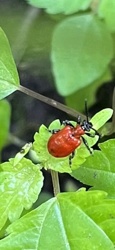
Spot the bright scarlet beetle that stands out sharply against green lily foliage.
Read the full Lily Leaf Beetle encyclopedia entry →Key Visual Features
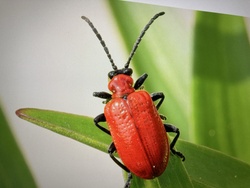
The lily leaf beetle is a small, elongated beetle around 6-9 mm long with a shiny, brilliant scarlet-red body that is hard to miss against green leaves. The head, legs, and antennae are black, creating a striking contrast with the red wing covers. The body is narrow and slightly rounded on top, with a smooth, glossy shell. The antennae are thread-like and about half the length of the body. If disturbed, adults often drop to the ground and land on their backs, showing their black underside, which makes them briefly harder to spot.
Where and When You're Likely to See Them
Lily leaf beetles are found wherever true lilies and fritillaries grow, including gardens, nurseries, and naturalized plantings. Adults emerge in spring as soon as lily shoots appear and remain active through summer, feeding and laying eggs on the undersides of leaves. Look for them clinging to leaves and stems during the day, especially on sunny mornings. Later in the season, watch for their larvae, which are soft-bodied, orange-brown to greenish grubs that often carry a covering of dark excrement on their backs as camouflage.
Similar-Looking Bugs
The lily leaf beetle's solid scarlet body with a black head can resemble certain red milkweed beetles or cardinal beetles, but those species are typically larger or have different antennae length and body proportions. Some blister beetles are also reddish, but they have a longer, more parallel-sided body and softer wing covers, whereas the lily leaf beetle is more compact and hard-shelled. The clearest confirmation is habitat: if a small, uniformly bright red beetle with a black head is on lily or fritillary foliage, it is almost certainly this species.
Quick ID Checklist
- Small beetle, about 6-9 mm, with a shiny scarlet-red body
- Black head, legs, and antennae contrasting with the red elytra
- Narrow, elongated-oval, smooth and glossy shell
- Found specifically on true lilies or fritillary plants
- Larvae appear as soft grubs often coated in dark debris on leaf undersides
Frequently asked questions
What plants are lily leaf beetles usually found on?
They are almost always found on true lilies (Lilium species) and fritillaries, since these are the host plants adults feed and lay eggs on.
Why did the beetle fall and flip over when I got close?
Lily leaf beetles often drop to the ground and land upside down as a startle response, briefly showing their black underside before flying or crawling away.
How do I recognize the larval stage?
Larvae are soft, humped, orange to greenish grubs that frequently carry a coating of their own dark excrement on their backs, which helps distinguish them from other leaf-feeding larvae.
Is the black head a reliable identification feature?
Yes, the combination of a solid black head with bright, unmarked scarlet wing covers is one of the most distinctive features separating this beetle from similarly colored red beetles.
Lily Leaf Beetle identified by the community
Recent Lily Leaf Beetle finds identified with Bug Identifier.