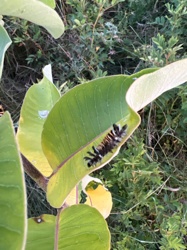
Monarch Caterpillar Identification Guide
Learn to recognize the bold yellow, black, and white bands that make the monarch caterpillar one of the easiest larvae to identify.
Read the full Monarch Caterpillar encyclopedia entry →Key Visual Features
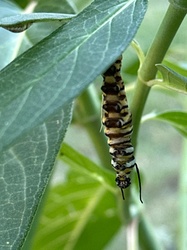
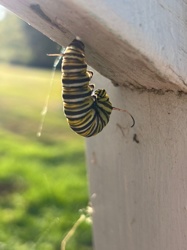
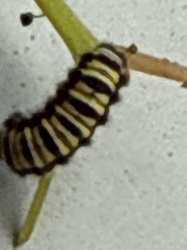
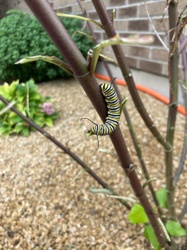
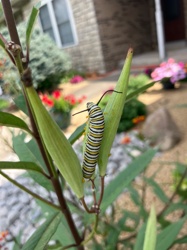
- Plump, smooth-bodied caterpillar with bold bands of yellow, black, and white encircling the entire body
- Two pairs of soft, fleshy black tentacle-like filaments — one longer pair near the head, one shorter pair near the rear — that are not true antennae
- Grows to about 2 inches long at full size, thickest in the middle and tapering slightly at both ends
- No spines or hairs — the body is smooth to the touch, unlike many spiny caterpillar species
- Distinct black false "face" band pattern near the head end
- Bright, high-contrast coloring that stands out clearly against green leaves
Where and When You'd See Them
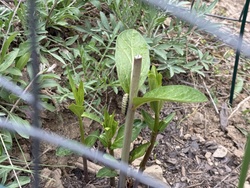
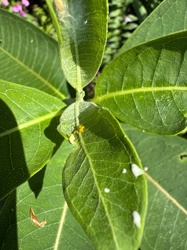
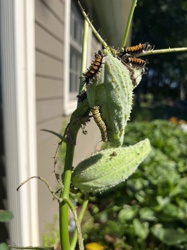
- Found exclusively on milkweed plants, since this is the only host plant the caterpillar feeds on
- Common in gardens, meadows, roadsides, and fields wherever milkweed grows
- Most visible from late spring through summer and into early fall, with multiple generations possible in a season
- Active during the day, typically found resting or feeding on milkweed leaves, stems, and flower buds
Similar-Looking Bugs
- Queen butterfly caterpillars look very similar but have an extra (third) pair of shorter filaments in the middle of the body, which monarch caterpillars lack.
- Black swallowtail caterpillars have a green body with black bands and yellow spots rather than the monarch's bold, uniform yellow-black-white stripes, and lack the long fleshy filaments.
- Milkweed tussock moth caterpillars, found on the same host plant, are covered in dense tufts of black, white, and orange hair rather than being smooth-bodied.
- Cabbage looper caterpillars are plain green and move with a distinctive looping crawl, quite different from the monarch's smooth striped pattern and normal crawl.
Quick ID Checklist
- Smooth body banded in bright yellow, black, and white stripes
- Two pairs of black fleshy filaments (longer at head, shorter at tail)
- Found only on milkweed plants
- No spines, hairs, or bristles anywhere on the body
- Up to about 2 inches long at maturity
Frequently asked questions
What plant will I always find a monarch caterpillar on?
Milkweed is the only host plant monarch caterpillars feed on, so finding this striped caterpillar elsewhere is very unlikely.
How do I tell a monarch caterpillar from a queen caterpillar?
Queen caterpillars share the same striped pattern but have three pairs of fleshy filaments instead of two, with an extra shorter pair in the middle of the body that monarchs lack.
Do monarch caterpillars have real antennae on their heads?
The long filaments near the head look antenna-like but are actually soft, fleshy sensory tentacles, not true antennae, which are much smaller and located on the actual head capsule.
How big does a monarch caterpillar get before it forms a chrysalis?
A full-grown monarch caterpillar reaches roughly 2 inches in length before it stops feeding and forms its chrysalis.
Monarch Caterpillar identified by the community
Recent Monarch Caterpillar finds identified with Bug Identifier.