Nursery Web Spider Identification Guide
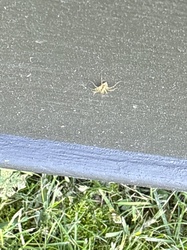
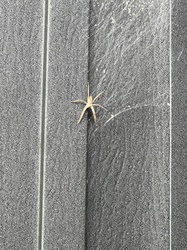
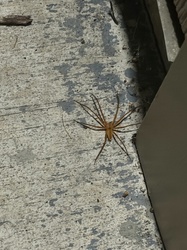
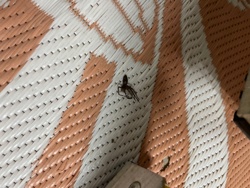
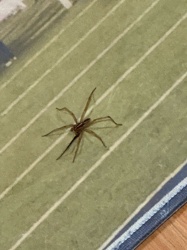
Identify the nursery web spider by its slender brown body, long legs, and the silk tent it spins to guard its young.
Read the full Nursery Web Spider encyclopedia entry →Key Visual Features
Nursery web spiders resemble wolf spiders but have their own set of identifying traits:
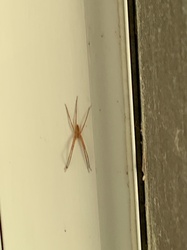
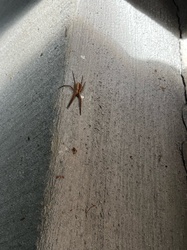
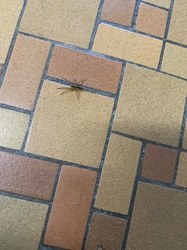
- Color: Typically brown, gray, or tan, often with a pale stripe running down the center of the back or a mottled pattern along the abdomen.
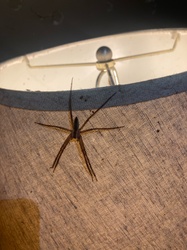
- Size: Body length usually around 0.5-0.75 inches, with a leg span that can reach 2 inches or more due to long, slender legs.
- Body shape: A slender, elongated body held low and flat, with legs that extend outward giving the spider a wide stance.
- Eyes: Eight eyes arranged in two rows of roughly similar size, unlike the enlarged rear eyes seen in wolf spiders.
- Egg sac carrying: A key identification behavior — females carry their round egg sac in their jaws (chelicerae) rather than attached to their spinnerets.
Where and When You'll See One
This species is found near vegetation edges, meadows, gardens, and woodland margins, often basking on leaves or tree bark in sunny spots. The most distinctive sign is the "nursery web" itself: shortly before eggs hatch, the female builds a silk tent-like structure among leaves or grass stems, places the egg sac inside, and stands guard nearby until the spiderlings disperse. These nursery tents are most visible in late spring through summer.
Similar-Looking Spiders
- Wolf spiders: Also brown and ground-dwelling, but wolf spiders carry their egg sac attached to their spinnerets, not in their jaws, and later carry spiderlings on their backs rather than building a nursery tent.
- Fishing spiders: Close relatives with a similar body shape but generally larger and found near water, often walking on the water's surface.
- Grass spiders: Build flat funnel webs rather than carrying an egg sac in their jaws or constructing a nursery tent.
Quick ID Checklist
- Slender brown to gray body with a pale central stripe
- Long legs held in a wide, flat stance
- Round egg sac carried in the jaws rather than on the spinnerets
- Silk nursery tent built among leaves or grass before eggs hatch
- Found basking on leaves or bark near vegetation edges and gardens
Frequently asked questions
What is the single clearest sign of a nursery web spider?
The distinctive silk tent, or nursery web, built among leaves and grass to hold the egg sac before hatching is unique to this group of spiders.
How do nursery web spiders differ from wolf spiders in caring for eggs?
Nursery web spiders carry their egg sac in their jaws and later build a guarded tent for it, while wolf spiders attach the egg sac to their spinnerets and carry spiderlings on their backs after hatching.
Where is the best place to look for a nursery web spider?
Check sunny leaf surfaces, bark, and low vegetation near meadows, gardens, and woodland edges, especially in late spring and summer when nursery tents appear.
Do nursery web spiders build a web to catch prey?
They are primarily active hunters that chase prey on foot rather than relying on a capture web, aside from the temporary nursery tent built for their eggs.
Nursery Web Spider identified by the community
Recent Nursery Web Spider finds identified with Bug Identifier.