Screwworm Fly Identification Guide
Identify the screwworm fly by its metallic blue-green body, three dark thoracic stripes, and orange-tinted face, distinguishing it from common blow flies.
Read the full Screwworm Fly encyclopedia entry →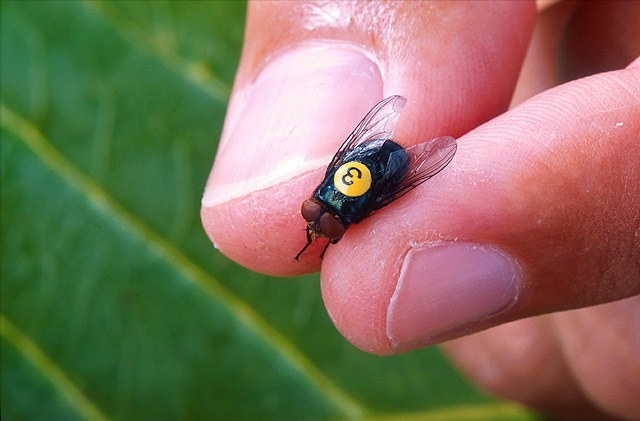
Key Visual Features
The screwworm fly is a metallic blow-fly relative with a few specific features that help separate it from more common blow flies.
- Size: Medium-sized, roughly 8-10 mm, similar in scale to a large house fly.
- Color: Bright metallic blue-green to bluish-green body with a glossy sheen, and a notably orange-toned face and lower head region.
- Body shape: Moderately robust, typical blow-fly build, with a rounded abdomen and a slightly humped thorax.
- Wings: Clear and unmarked, held flat and slightly spread over the back at rest.
- Legs: Dark, moderately long, and bristled.
- Antennae: Short, typical fly-style, with a feathery bristle.
- Distinctive markings: Three narrow, dark longitudinal stripes on the thorax are a helpful identifying feature, along with the orange facial coloring that stands out against the metallic body.
Where and When You'll See Them
Screwworm flies are found in warm regions, historically across parts of the Americas, and are most active in warm to hot weather. Adults are typically encountered outdoors in pastures, rangeland, and areas near livestock or wild mammals, since the species' life cycle centers on host animals. They tend to be most active during the day in warm months, seeking out hosts in sunlit, open habitats rather than shaded or indoor areas.
Similar-Looking Bugs
- Common blow flies (e.g., bottle flies): Share the metallic blue-green sheen, but typically lack the three distinct dark thoracic stripes and the notably orange facial coloring seen in the screwworm fly.
- House flies: Duller gray overall without metallic coloring, easily ruled out by the lack of any shine.
- Flesh flies: Gray with a checkered abdomen pattern rather than a glossy metallic body, making them visually quite distinct from the screwworm fly's shine.
Quick ID Checklist
- Bright metallic blue-green, glossy body
- Orange-toned face contrasting with the metallic body color
- Three narrow dark stripes running along the thorax
- Medium size (8-10 mm), typical blow-fly build
- Found outdoors in warm pastures and rangeland near host animals
Frequently asked questions
What is the key feature that separates a screwworm fly from a regular blow fly?
Look closely at the thorax and face: the screwworm fly shows three distinct narrow dark stripes on the thorax and a notably orange-toned face, features that most common metallic blow flies lack.
What color is the screwworm fly's body?
It has a bright, glossy metallic blue-green sheen similar to many blow flies, but paired with the distinctive orange facial coloring and thoracic striping described above.
In what type of habitat would I encounter a screwworm fly?
Outdoor, warm-climate settings such as pastures and rangeland where host mammals are present, typically during the day in warm months.
How big is a screwworm fly compared to a house fly?
It's roughly similar in size or slightly larger, around 8-10 mm, but easily told apart by its shiny metallic coloring compared to the dull gray of a house fly.
Screwworm Fly identified by the community
Recent Screwworm Fly finds identified with Bug Identifier.