Spider Mite Identification Guide
Learn to spot spider mites and their fine silk webbing on the undersides of leaves.
Read the full Spider Mite encyclopedia entry →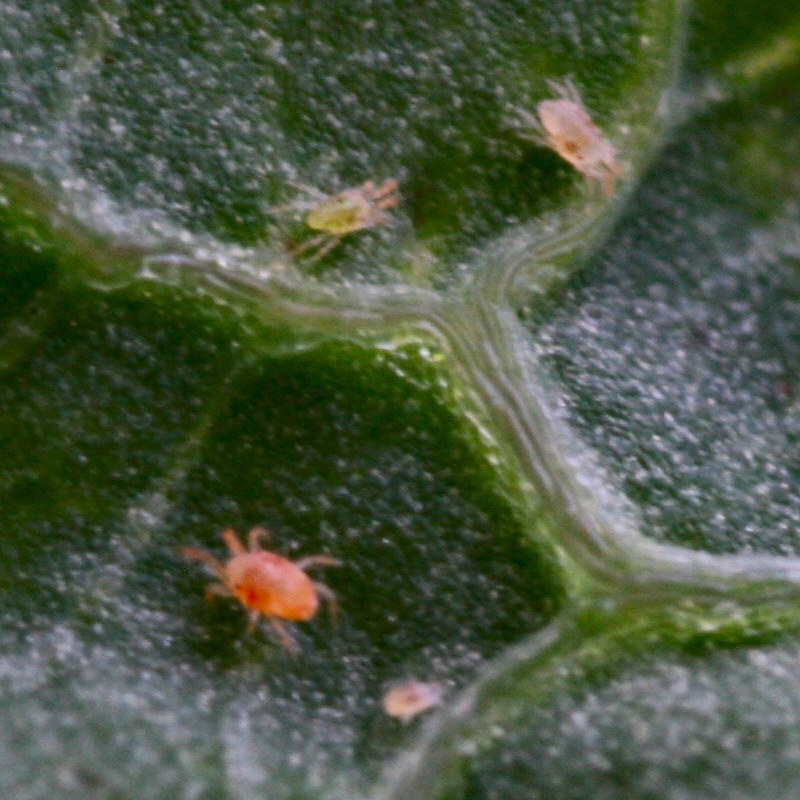
Key Visual Features
Spider mites are among the smallest arachnids you can identify without magnification, though a hand lens helps enormously.
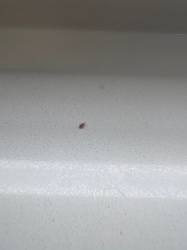
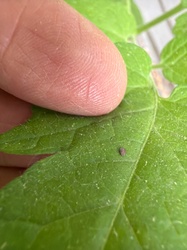
- Size: About 0.3–0.5 mm long, roughly the size of a grain of ground pepper.
- Color: Ranges from pale yellow-green to reddish-orange or brown, often with two dark spots visible on the back through the translucent body.
- Body shape: Oval, soft-bodied, with no clear separation between head and abdomen.
- Legs: Eight legs (they are arachnids, not insects), giving them a spider-like gait when viewed up close.
- Wings/antennae: None — mites lack wings and antennae entirely.
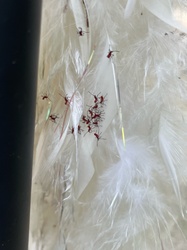
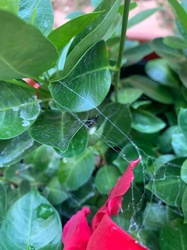
- Markings: Fine, silky webbing strands are often the easiest clue, spun across leaf surfaces and between stems.
Where and When You'd See Them
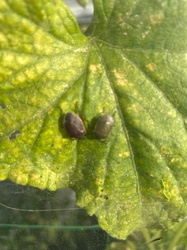
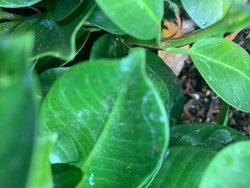
Spider mites favor the undersides of leaves on garden plants, houseplants, and agricultural crops. They thrive in hot, dry conditions and populations build quickly in summer. Look closely at stippled, dusty-looking foliage — the mites themselves are easiest to see by tapping a leaf over a sheet of white paper and watching for tiny specks that start moving. Colonies tend to expand outward from a single leaf, so nearby foliage often shows a gradient from heavily webbed and stippled to barely touched.
Similar-Looking Bugs
- Clover mites are a similar size but usually reddish overall, with notably long front legs, and are found on window sills and foundations rather than webbing on leaves.
- Aphids are larger, have visible antennae and sometimes wings, and cluster on stems rather than spinning webbing.
- Thrips are slender, winged insects with six legs, distinctly different from the eight-legged, wingless spider mite.
- Predatory mites look similar but move faster and are usually less numerous than the pest species they hunt.
Quick ID Checklist
- Eight legs, no wings, no antennae, under half a millimeter long
- Fine silk webbing on leaf undersides or between stems
- Fine light stippling or bronzing visible on upper leaf surface
- Tiny specks that move when tapped onto white paper
- Two dark internal spots often visible on a pale, translucent body
Frequently asked questions
How can I tell if tiny leaf specks are spider mites and not dust?
Tap the leaf firmly over a sheet of white paper. Dust stays put, while spider mites will begin crawling within a few seconds.
Do spider mites always leave webbing?
Fine silk webbing is a strong identifying clue, especially at higher population densities, but very light infestations may show only leaf stippling without obvious webbing.
Are spider mites insects?
No, they are arachnids with eight legs and no antennae or wings, placing them in the same broad group as spiders and ticks rather than true insects.
What color are spider mites?
Coloring varies from pale green or yellow to reddish-brown, and can shift with season and species, but two dark internal spots are commonly visible.
Spider Mite identified by the community
Recent Spider Mite finds identified with Bug Identifier.