Stable Fly Identification Guide
The stable fly looks like an ordinary house fly at rest but reveals a forward-pointing, spear-like proboscis that gives away its identity.
Read the full Stable Fly encyclopedia entry →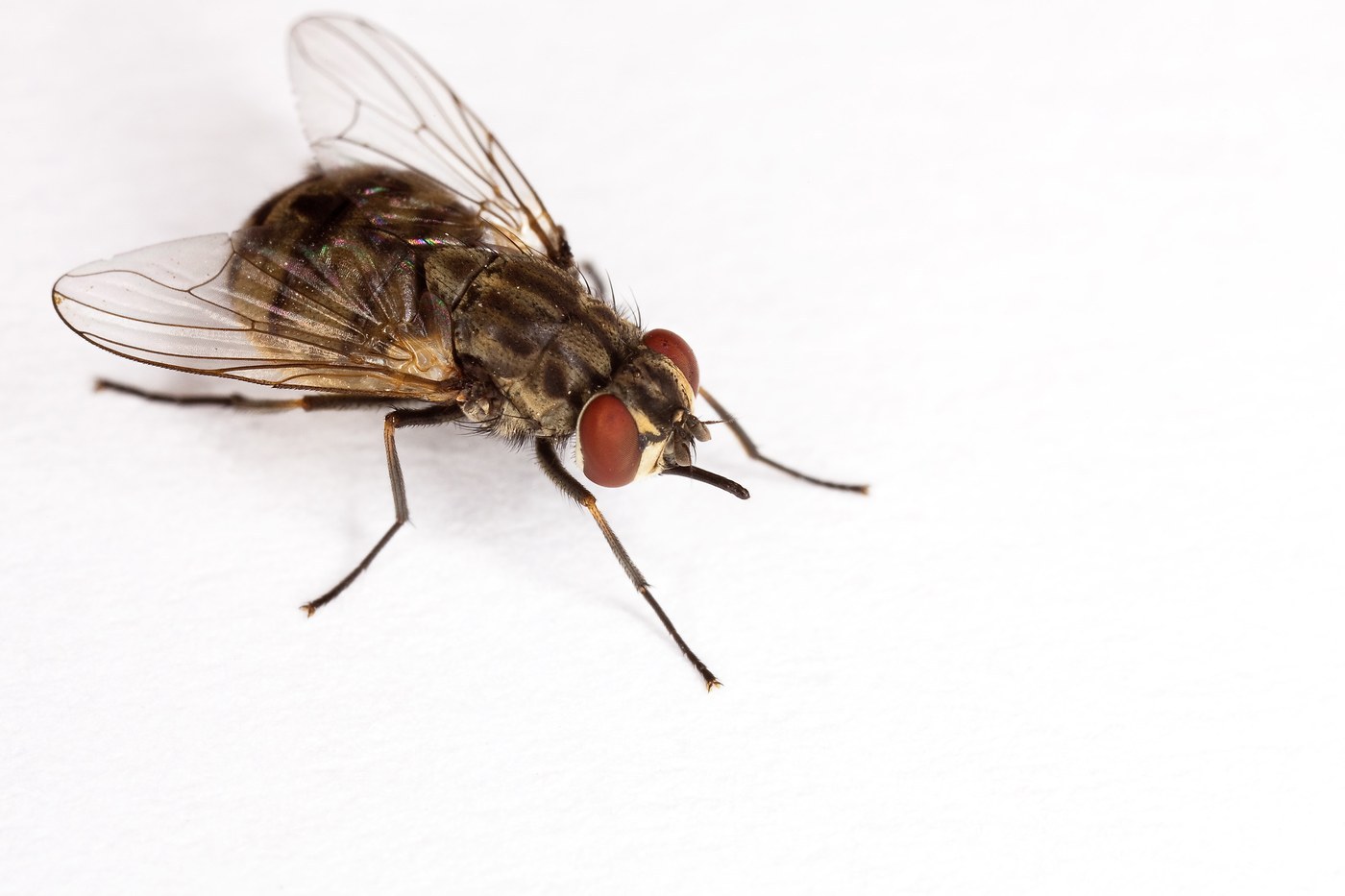
Key Visual Features
Stable flies (Stomoxys calcitrans) closely resemble house flies but have one key feature that sets them apart.
- Size: About 6-8 mm long, similar in size to a house fly.
- Body color: Gray thorax with four narrow dark stripes, and a checkered pattern of dark spots on the abdomen.
- Proboscis: The defining feature — a slender, rigid, forward-projecting proboscis extending in front of the head, visible even when the fly is at rest.
- Wings: Clear, held slightly apart in a loose V when resting, unlike the tightly folded wings of a house fly.
- Eyes: Reddish-brown compound eyes, smaller relative to head size than in many other flies.
- Posture: Often rests with the head angled downward, making the pointed proboscis easy to spot from the side.
Where and When You'll See It
- Common around livestock areas, barns, stables, and pastures, as well as beaches and lawns with decaying organic matter.
- Larvae develop in damp, decaying vegetation such as grass clippings, straw, and manure-contaminated bedding.
- Most active during the day, particularly on overcast days or in shaded areas, unlike house flies which favor bright sun.
- Populations peak in late summer, especially near coastal areas and farmland.
Similar-Looking Bugs
- House fly: Lacks a visible forward-pointing proboscis and rests with wings folded tightly over the back.
- Face fly: Similar size and coloring but without the rigid piercing proboscis; face flies have sponging mouthparts instead.
- Flesh fly: Larger, with a distinct gray-and-black checkerboard abdomen and no piercing proboscis.
Behavior Notes
Unlike house flies, which feed on liquids by sponging surfaces, the stable fly uses its rigid proboscis to pierce skin and take blood meals from animals and people, landing low on the legs and ankles rather than the face. This ground-level, ankle-biting habit combined with the visible proboscis is often the quickest way to confirm an identification without needing a closer look at the wing or abdomen markings.
Quick ID Checklist
- Rigid, forward-pointing proboscis visible at rest
- Gray thorax with four dark stripes
- Checkered dark spots on the abdomen
- Wings held slightly apart, not tightly folded
- Common near livestock, beaches, and decaying grass clippings
Frequently asked questions
What is the single best way to identify a stable fly?
Look for the slender, rigid proboscis pointing forward from the head, even when the fly is resting — house flies lack this visible piercing structure.
Why do stable flies seem more common on cloudy days?
Unlike house flies, stable flies are often more active in shaded or overcast conditions rather than favoring direct bright sunlight.
Where do stable fly larvae typically develop?
They develop in damp, decaying organic matter such as grass clippings, straw, seaweed, and manure-contaminated bedding around barns and beaches.
How can I tell a stable fly from a house fly on a windowsill?
Check the head profile: a stable fly shows a needle-like proboscis projecting forward, while a house fly's mouthparts are not visible as a rigid point.
Stable Fly identified by the community
Recent Stable Fly finds identified with Bug Identifier.