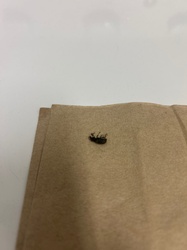
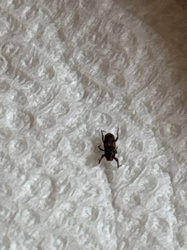
Weevil Identification Guide
Spot a weevil instantly by its unmistakable elongated snout and elbowed antennae.
Read the full Weevil encyclopedia entry →
Key Visual Features
Weevils (superfamily Curculionoidea) are a huge and diverse group of beetles, but nearly all share one unmistakable feature — an elongated snout:
- A distinct elongated snout (rostrum) extending forward from the head, often as long as or longer than the rest of the head, with chewing mouthparts located at the very tip
- Elbowed (geniculate) antennae, bent sharply partway along their length and often clubbed at the tip, usually attached partway along the snout rather than at the base of the head
- Compact, oval to rounded body, typically small, ranging from about 2 mm to over 2 cm (0.08–0.8 inches) depending on species
- Hard, textured wing covers (elytra), often gray, brown, or black, sometimes with fine patterns of scales, spots, or ridges
- Ability to feign death, tucking legs and snout close to the body and dropping motionless when disturbed
- Short legs relative to body size, adapted more for walking and clinging to plant surfaces than for jumping or fast running
Where and When You'd See It
Weevils are found nearly worldwide, wherever their host plants grow, since most species feed on specific plants, seeds, grains, nuts, or stored plant products. They are commonly seen on foliage, flowers, seed pods, and tree bark during the growing season, from spring through fall in temperate climates, and year-round in warmer regions. Some species are found indoors in stored food products such as grains, flour, or dried beans, where they can be active at any time of year given suitable conditions.
Similar-Looking Bugs
- Other beetles without a snout: the presence of an elongated rostrum with mouthparts at the tip is the clearest way to separate weevils from beetles that simply have an elongated head or body
- Bark beetles: smaller and more cylindrical, lacking the pronounced snout of true weevils
- Ants: elbowed antennae are shared with ants, but ants lack the beetle's hardened wing covers and elongated snout, and have a distinctly pinched waist that weevils do not
Quick ID Checklist
- Elongated snout with mouthparts at the tip
- Elbowed, often clubbed antennae attached along the snout
- Compact, oval body with hard wing covers
- Small size, generally under 2 cm
- Found on host plants, seeds, or stored grain products
Frequently asked questions
What is the single most reliable way to identify a weevil?
Look for the elongated snout, or rostrum, projecting from the front of the head, with the beetle's chewing mouthparts located at the very tip — this feature is unique to weevils among common beetles.
How are a weevil's antennae different from other beetles?
A weevil's antennae are elbowed, bending sharply partway along their length, and are typically attached along the snout rather than at the base of the head as in most other beetles.
Do all weevils look the same?
No, weevils are an extremely diverse group varying widely in size, color, and snout length, but nearly all share the defining elongated rostrum and elbowed antennae.
Where would I typically find a weevil?
Weevils are usually found on the specific plants, seeds, or stored grain products they feed on, since most species are closely tied to a particular food source.
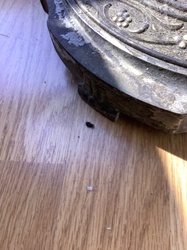
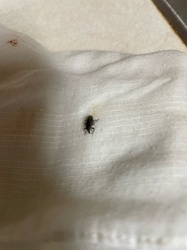
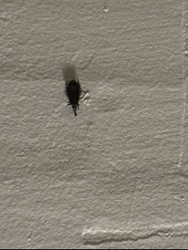
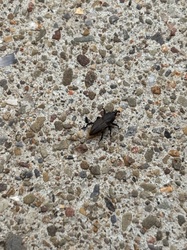
Weevil identified by the community
Recent Weevil finds identified with Bug Identifier.