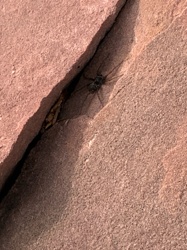
Wolf Spiderling Identification Guide
Learn how to recognize a wolf spiderling, the juvenile stage of a wolf spider, by its mini proportions and eye pattern.
Read the full Wolf Spiderling encyclopedia entry →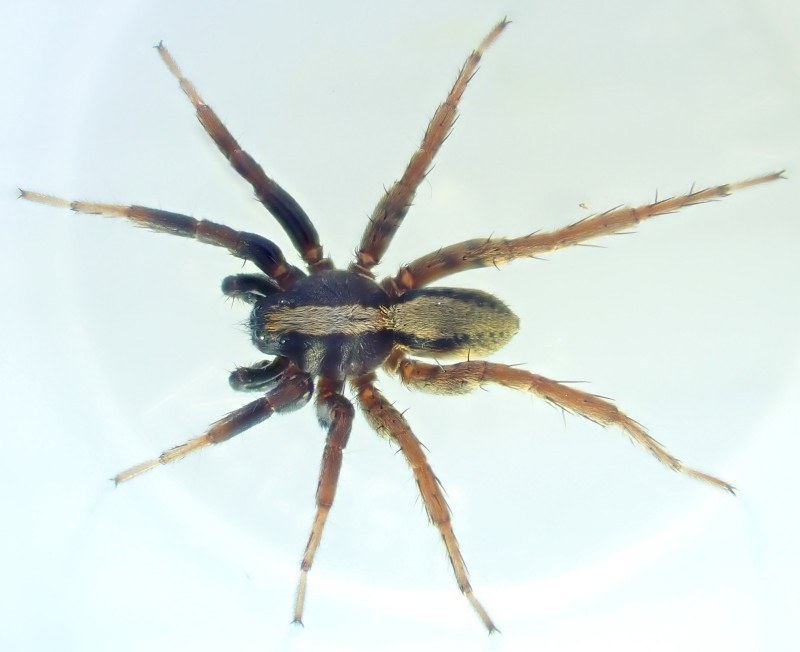
Key Visual Features
A wolf spiderling is simply a young, immature wolf spider, recently hatched or recently dispersed from its mother's back.
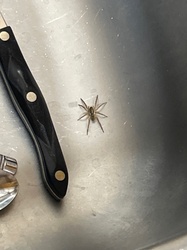
- Size: Very small, often only 2-6 mm in body length, much smaller than an adult wolf spider.
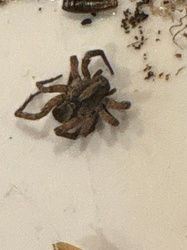
- Color: Mottled brown, gray, or tan, similar in pattern to adults but sometimes paler or less distinctly marked until after a few molts.
- Body shape: Compact and proportionally shorter-legged than adults, with a rounder abdomen relative to body size.
- Eyes: Eight eyes arranged in the classic wolf spider pattern — a bottom row of four small eyes, a middle row of two very large eyes, and a top row of two medium eyes. This pattern is present even in spiderlings and is the most reliable feature for identification.
- Legs: Eight legs, already showing the sturdy, slightly hairy build typical of wolf spiders, used for fast running rather than web building.
Where and When You'd See It
Wolf spiderlings are found in the same habitats as adults — leaf litter, grass, gardens, and open ground — but are most noticeable just after hatching, when dozens of siblings may still be riding together on their mother's abdomen or dispersing in a loose cluster nearby. This is commonly observed in spring and summer. Once dispersed, spiderlings hunt alone on the ground, mostly active at dusk and at night.
Similar-Looking Bugs
- Other small ground spiders (e.g., young ground spiders or ant-mimics): Lack the two enlarged middle eyes that give wolf spiders their reflective, forward-staring look.
- Nursery web spiderlings: Similar size and coloring, but nursery web spider eyes are more evenly sized across all three rows rather than featuring the two oversized middle eyes.
- Adult wolf spiders: Same eye pattern and general shape but much larger and more heavily built.
Quick ID Checklist
- Very small size (a few millimeters), clearly juvenile proportions
- Two noticeably large, forward-facing middle eyes (often reflect light at night)
- Mottled brown/gray coloring similar to adult wolf spiders
- Found in clusters near a mother spider or scattered in grass/leaf litter
- Fast, running movement rather than web-based locomotion
Behavior Notes
Wolf spiderlings ride on their mother's back for a period after hatching before dispersing to hunt independently on the ground, relying on speed and eyesight rather than webs to find prey.
Frequently asked questions
How do I know a tiny spider is a wolf spiderling and not another species?
Check the eyes: wolf spiders, even as spiderlings, have two unusually large forward-facing middle eyes that often catch and reflect light, a pattern not shared by most other small ground spiders.
Why might I see a cluster of tiny spiders on a larger spider's back?
Female wolf spiders carry their newly hatched spiderlings on their abdomen for a period before the young disperse, so a cluster of tiny spiders riding an adult is a classic wolf spider sighting.
Do wolf spiderlings build webs?
No, like adult wolf spiders they are active ground hunters and do not build webs to capture prey.
When are wolf spiderlings most commonly seen?
Most often in spring and summer following hatching, and most active around dusk and at night when they move through grass and leaf litter.
Wolf Spiderling identified by the community
Recent Wolf Spiderling finds identified with Bug Identifier.