Dust Mite Identification Guide
Learn what sets dust mites apart, from their microscopic size to their translucent, eight-legged bodies.
Read the full Dust Mite encyclopedia entry →Key Visual Features
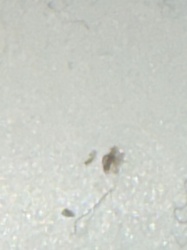
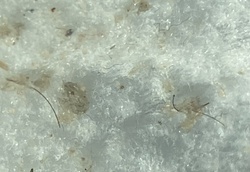
Dust mites are microscopic arachnids, far too small to identify with the naked eye, but their features are well documented under magnification.
- Size: Roughly 0.2 to 0.3 mm in length — invisible without a microscope.
- Body shape: Rounded, oval body without a clear separation between head and body segments, typical of mites.
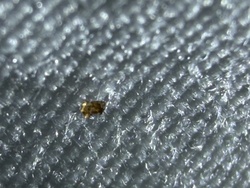
- Color: Translucent to pale white or cream colored, giving them a glassy appearance under magnification.
- Legs: Eight legs in adults, each ending in small claw-like structures adapted for gripping fibers.
- Surface texture: Body covered in fine, short bristles rather than smooth skin.
Where and When You'd See One
Because dust mites cannot be seen without magnification, identification relies entirely on environment and indirect signs rather than visual spotting.
- Found in soft, fibrous household materials such as mattresses, pillows, upholstered furniture, carpets, and curtains
- Thrive in warm, humid indoor conditions with limited light
- Present year-round indoors, with populations often peaking in humid seasons
- Cannot be observed directly during normal daily activity; confirming their presence typically requires laboratory sampling or microscopy
Similar-Looking Bugs
- Mold spores and household dust particles are non-living and lack any leg or body structure, distinguishing them from mites under a microscope.
- Booklice (psocids) are visible to the naked eye as tiny pale insects, unlike dust mites, which require magnification to see at all.
- Other household mites, such as mold mites or grain mites, share a similar microscopic size and pale coloring, and are generally distinguished from dust mites by the specific material they are found in (food products versus fibrous furnishings) and by microscopic examination.
- Spider mites are plant pests found on leaves rather than household fabrics, and though similarly tiny, they are associated with a different habitat.
Quick ID Checklist
- Microscopic size, not visible without magnification
- Translucent to pale, oval body with eight legs
- Fine bristles covering the body surface
- Found in soft, fibrous indoor materials like bedding and upholstery
- Confirmed presence generally requires microscopic or laboratory examination rather than visual spotting
Frequently asked questions
Can dust mites be seen with the naked eye?
No, they are microscopic, roughly 0.2 to 0.3 mm long, and require a microscope to observe their body structure.
What color are dust mites under a microscope?
They appear translucent to pale white or cream colored, giving them a glassy look.
Where in a home are dust mites typically found?
They are associated with soft, fibrous materials such as mattresses, pillows, upholstered furniture, and carpets.
How is a dust mite different from a spider mite?
Both are tiny mites, but spider mites are found on plant leaves outdoors or in gardens, while dust mites are associated with indoor fabrics and furnishings.
Dust Mite identified by the community
Recent Dust Mite finds identified with Bug Identifier.