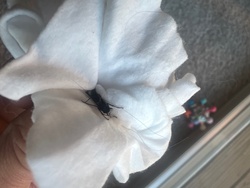
Field Cricket Identification Guide
Learn to identify field crickets by their dark, robust bodies, long antennae, and familiar nighttime chirping in grassy areas.
Read the full Field Cricket encyclopedia entry →Key Visual Features
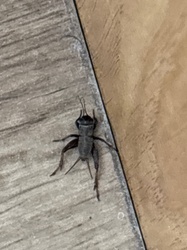
Field crickets are among the most recognizable singing insects, with a stocky, rounded build well suited to life on the ground.
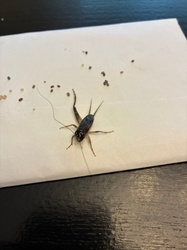
- Body: Robust and somewhat rounded, typically 0.5 to 1 inch long, with a large head relative to the body.
- Color: Usually dark brown to shiny black, occasionally with slightly lighter markings on the wings.
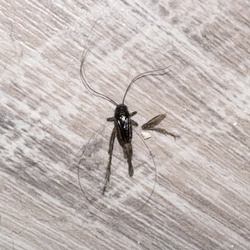
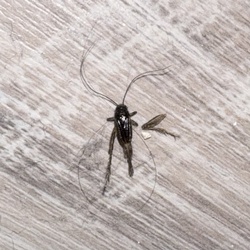
- Antennae: Very long and thread-like, often extending well beyond the length of the body.
- Legs: The hind legs are large and strongly muscled, adapted for powerful jumping.
- Wings: Folded flat over the back; males have textured forewings used to produce their familiar chirping song by rubbing them together, while females have a long, needle-like ovipositor extending from the rear of the abdomen.
Where and When You'd See Them
Field crickets are common in grassy fields, meadows, gardens, and along roadsides, particularly from mid-summer through fall when adults are most abundant. They are largely nocturnal, hiding by day under stones, logs, leaf litter, or in burrows, and becoming active after dusk, when the males' familiar rhythmic chirping can be heard carrying across open grassy areas. Warm summer and early autumn evenings are peak calling times, with activity often continuing into the night.
Similar-Looking Bugs
- House crickets: Lighter tan or straw-colored with darker banding on the head, versus the uniformly dark body of field crickets.
- Camel crickets: Lack wings entirely and have a distinctly humped back with no chirping ability, unlike the flatter-backed, singing field cricket.
- Mole crickets: Have shovel-like enlarged front legs for digging, very different from the field cricket's jumping hind legs.
- Katydids: Longer, leaf-shaped wings and a more elongated green or brown body, quite different from the compact, rounded field cricket.
Quick ID Checklist
- Stocky, rounded dark brown to black body, roughly half an inch to an inch long
- Very long, thread-like antennae
- Large, muscular hind legs built for jumping
- Females show a long, needle-like ovipositor at the rear
- Heard chirping rhythmically after dusk in grassy fields and gardens
Frequently asked questions
How can I tell a field cricket from a house cricket?
Field crickets are uniformly dark brown to black, while house crickets are lighter tan or straw-colored with distinct darker bands on the head.
What is the long spike at the back of some crickets?
That is the ovipositor, a needle-like egg-laying structure found only on females, used to help identify the sex of the cricket.
When are field crickets most active?
They are primarily nocturnal, becoming active after dusk, with peak chirping activity during warm summer and early fall evenings.
How do field crickets differ from camel crickets?
Field crickets have wings, a flatter back, and produce a chirping call, while camel crickets are wingless, have a distinctly humped back, and are silent.
Field Cricket identified by the community
Recent Field Cricket finds identified with Bug Identifier.