Forest Tent Caterpillar Identification Guide
Distinguish this gregarious hardwood caterpillar by the row of pale keyhole-shaped spots running down its back.
Read the full Forest Tent Caterpillar encyclopedia entry →Key Visual Features
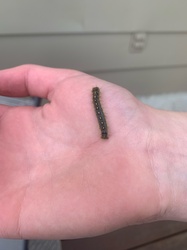
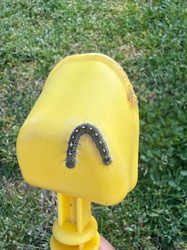
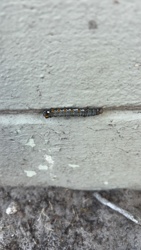
The forest tent caterpillar is a social, hairy caterpillar known for the distinctive markings running down its back.
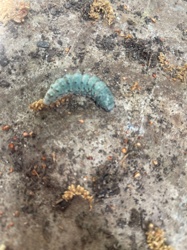
- Body color: Bluish-gray to dark blue-gray, with a somewhat velvety appearance from fine, sparse hairs.
- Back markings: A single row of pale, cream to white spots shaped like footprints or keyholes runs down the center of the back — this is the single best field mark for the species.
- Side markings: Thin blue and orange/yellow lines run along the sides of the body, bordered by fine hair.
- Size: Reaches about 2 inches (5 cm) at maturity.
- Head: Blue-gray with fine mottling, not strongly patterned.
Where and When You'll See It
Forest tent caterpillars feed on a wide range of hardwood trees, especially sugar maple, oak, aspen, and birch, across much of North America. They are most visible in spring, when larvae hatch and feed gregariously, often seen traveling in nose-to-tail processions along branches and trunks using silk trails. Despite the name, this species does not build the large silk tents typical of its relatives — instead, groups rest together on silk mats spun on trunks or branches between feeding periods.
Similar-Looking Caterpillars
- Eastern tent caterpillar: Builds conspicuous silk tents in tree branch forks and has a solid white stripe running down the back rather than a row of separate keyhole-shaped spots.
- Western tent caterpillar: Similar tent-building habit to the eastern species, with orange and blue markings but a more continuous back stripe compared to the forest tent caterpillar's spot pattern.
- Gypsy moth (spongy moth) caterpillar: Has paired blue and red dots along the back rather than a single row of pale keyhole spots, and is more heavily bristled with longer hair tufts.
Quick ID Checklist
- Bluish-gray body with a row of pale keyhole/footprint-shaped spots down the back
- Thin blue and orange side stripes
- Gregarious behavior, often seen moving in groups along silk trails
- No large enclosed silk tent built (distinguishes it from the eastern tent caterpillar)
- Found on sugar maple, oak, aspen, or birch in spring
Frequently asked questions
Does the forest tent caterpillar actually build a tent?
No, unlike the eastern tent caterpillar, it does not build an enclosed silk tent — it rests in groups on silk mats spun on bark rather than in a woven nest.
What is the key difference between forest and eastern tent caterpillars?
The forest tent caterpillar has a row of separate pale keyhole-shaped spots down its back, while the eastern tent caterpillar has one continuous white stripe.
When are forest tent caterpillars most commonly seen?
They are most active and visible in spring, shortly after leaves emerge on their host trees.
What trees are most likely to host forest tent caterpillars?
Sugar maple, oak, aspen, and birch are among the most common hosts across their range.
Forest Tent Caterpillar identified by the community
Recent Forest Tent Caterpillar finds identified with Bug Identifier.