Rat-Tailed Maggot Identification Guide
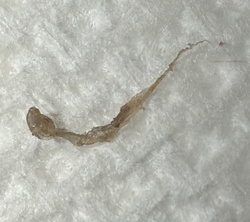
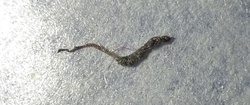
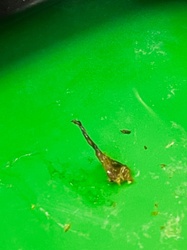
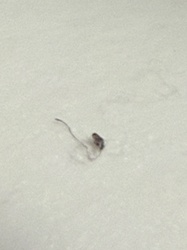
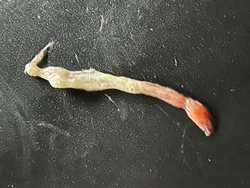
Recognize this distinctive aquatic fly larva by its long, telescoping breathing tube trailing behind a soft, grayish body.
Read the full Rat-Tailed Maggot encyclopedia entry →Key Visual Features
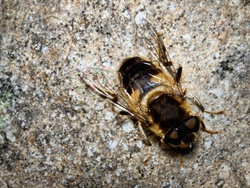
The rat-tailed maggot is the aquatic larval stage of certain hoverflies, easily identified by its unusual extendable tail.
- Size: Body typically 15-20 mm long, with the breathing tube capable of stretching much longer, sometimes reaching several times the body length depending on water depth.
- Color: Dull grey, beige, or brownish, with a soft, semi-translucent, wrinkled skin.
- Body shape: Plump, cylindrical, and legless, tapering toward the rear where the breathing tube extends.
- The "rat tail": A long, thin, telescoping siphon tube extends from the rear of the abdomen up to the water surface, allowing the larva to breathe air while remaining submerged in mud or stagnant water — this tail is the single most distinctive feature.
- Head end: Small and inconspicuous, with tiny mouth hooks used for filtering organic matter from mud and decaying material.
- Prolegs: Instead of true legs, the larva has small fleshy prolegs (stubby projections) on its underside used to shuffle through sediment.
Where and When You'd See It
Rat-tailed maggots live in stagnant, oxygen-poor water rich in decaying organic matter, such as manure-contaminated pools, muddy ditches, shallow puddles, and the sludgy bottoms of neglected water containers. The extendable tail lets them stay in low-oxygen mud while still breathing surface air. They are most commonly found in warmer months, from late spring through autumn, before pupating and emerging as adult hoverflies.
Similar-Looking Bugs
- Other fly larvae (maggots): Lack the long telescoping tail entirely and are generally shorter and more uniformly cylindrical without a breathing siphon.
- Soldier fly larvae: Have a flattened, segmented, tough-skinned body with a short, blunt rear end rather than a long extendable tube.
- Mosquito larvae: Much smaller and more slender, with a short, fixed breathing siphon rather than a long telescoping tail, and they move with a wriggling motion near the surface.
Quick ID Checklist
- Soft, plump, grey-brown legless larva around 15-20 mm long
- Long, thin, telescoping tail used for breathing at the surface
- Found in stagnant, muddy, organic-rich water or sludge
- Tiny fleshy prolegs instead of true legs
- Tail length adjusts with water depth, stretching when submerged deeper
Frequently asked questions
What is the single feature that instantly identifies a rat-tailed maggot?
The long, thin, telescoping tail extending from the rear of the body, used as a breathing tube reaching to the water surface, is unique to this larva and not shared by other aquatic fly larvae.
Why does the tail change length?
The tail is telescoping and extends or retracts to match the depth of water above the larva, always keeping its tip at the surface for air while the body stays submerged in mud.
What kind of water is most likely to contain rat-tailed maggots?
Stagnant, low-oxygen water with abundant decaying organic matter, such as muddy ditches, manure-tainted pools, or sludgy neglected containers, is the typical habitat.
How is a rat-tailed maggot different from a mosquito larva?
A rat-tailed maggot is larger, plumper, and has a long telescoping tail, while a mosquito larva is slender, wriggles actively near the surface, and has only a short fixed breathing siphon.
Rat-Tailed Maggot identified by the community
Recent Rat-Tailed Maggot finds identified with Bug Identifier.