Southern Black Widow Identification Guide
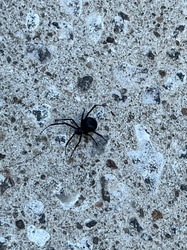
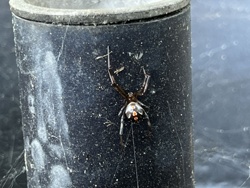
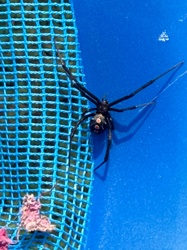
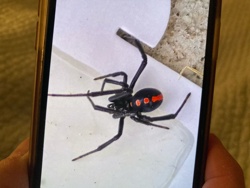
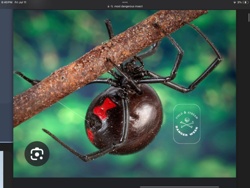
Identify the southern black widow by its shiny jet-black body and the classic red hourglass marking underneath.
Read the full Southern Black Widow encyclopedia entry →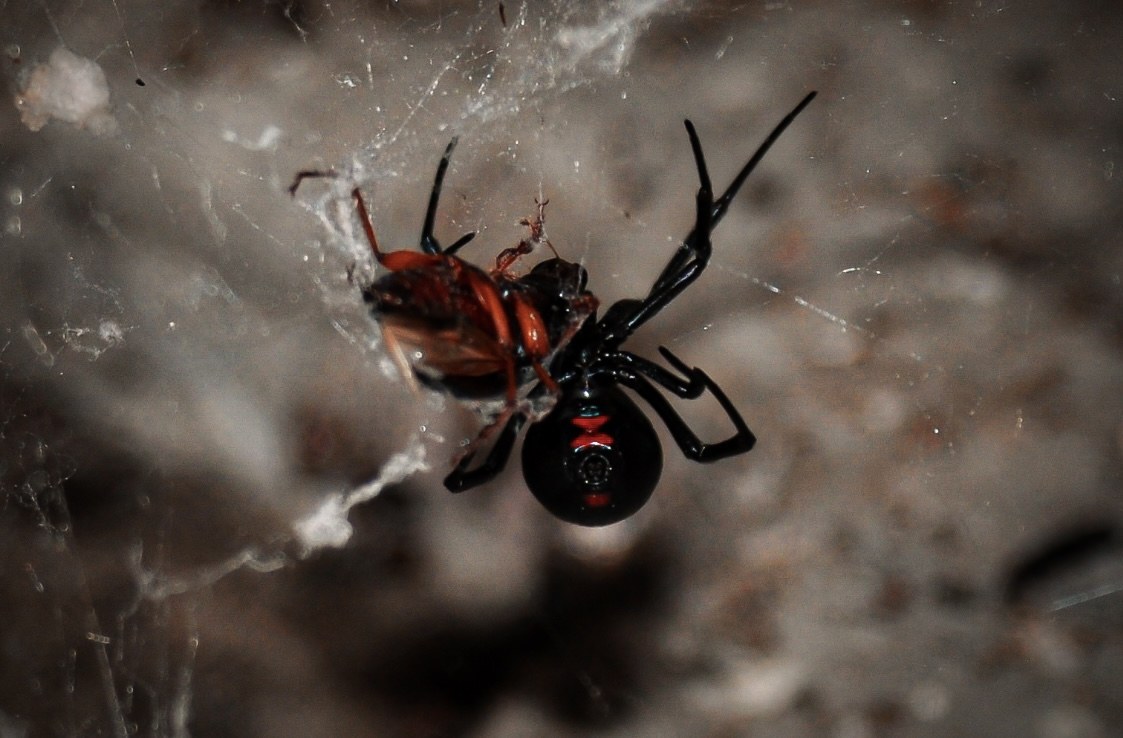
Key Visual Features
The southern black widow is the classic widow spider silhouette most people picture:
- Color: Deep, glossy jet-black body with a smooth, shiny surface that reflects light.
- Abdomen shape: A large, round, bulbous abdomen that looks disproportionately big compared to the thin legs and small head region.
- Hourglass marking: A bright red or orange hourglass shape on the underside of the abdomen, usually complete and well-formed in this species.
- Size: Females measure roughly 0.5 inches in body length with a leg span near 1.5 inches; males are much smaller, lighter in color, and often marked with pale stripes or spots.
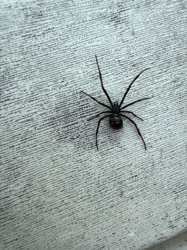
- Legs: Long, slender, jointed black legs that appear delicate against the rounded body.
Where and When You'll See One
This species is common across the southeastern and southern United States, favoring dry, undisturbed spots close to the ground such as woodpiles, sheds, under rocks, in crevices of stone walls, and cluttered garage corners. Their irregular, tangled cobweb-style webs are usually built in a dark, protected space. Adult females can be seen year-round in warmer climates but are most noticeable in late summer and fall when they are largest and webs are most developed.
Similar-Looking Spiders
- Western black widow: Very similar in color and shape, but the hourglass marking often looks more hourglass-distinct while range and habitat differ, with the western species favoring drier, more arid regions.
- Northern black widow: Tends to show the red marking broken into two separate triangles rather than one connected hourglass, plus extra red spots along the back.
- False widow spiders: Have a more brown-purple tint and a cream-colored band near the front of the abdomen instead of a red hourglass.
Quick ID Checklist
- Glossy black, round abdomen much larger than the head and legs
- Complete red or orange hourglass marking on the underside
- Long, thin black legs on a compact body
- Tangled, irregular web in a dark, sheltered, low spot
- Found in woodpiles, sheds, and undisturbed corners across the southern US
Frequently asked questions
What is the easiest single feature to check for identification?
Flip a light beneath the web (without disturbing it) to check the underside of the abdomen for the red hourglass marking, which is the most reliable identification feature.
How can I tell males and females apart?
Females are larger, glossy black, and round-bodied, while males are noticeably smaller, lighter brown or tan, and often marked with pale stripes or spots.
Do southern black widows always build their webs outdoors?
They favor sheltered, undisturbed spots which are often outdoors like woodpiles and sheds, but they can also occupy similarly dark, cluttered indoor corners.
How does the southern black widow's hourglass differ from the northern species?
The southern black widow usually shows one connected hourglass shape, while the northern black widow's marking is typically split into two separate triangular shapes.
Southern Black Widow identified by the community
Recent Southern Black Widow finds identified with Bug Identifier.