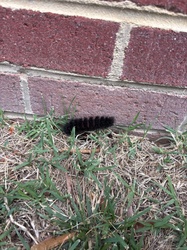
Giant Leopard Moth Caterpillar Identification Guide
Learn to spot the giant leopard moth caterpillar by its glossy black bristles and bright red bands revealed when it curls up.
Read the full Giant Leopard Moth Caterpillar encyclopedia entry →Key Visual Features
The giant leopard moth caterpillar is the larval stage of Hypercompe scribonia, a large white spotted moth.
- Size: grows to about 2 to 3 inches long at maturity.
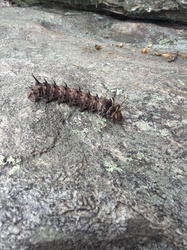
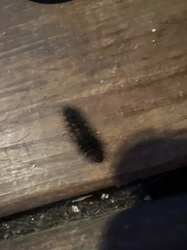
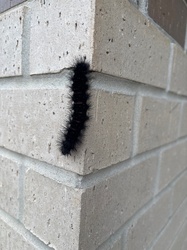
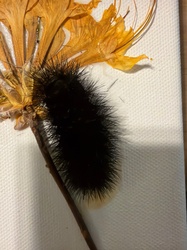
- Color: densely covered in stiff, glossy black bristles that give the whole caterpillar a dark, almost velvety look.
- Hidden markings: between the body segments are bands of red to orange-red skin, only visible when the caterpillar curls into a tight ball or stretches its segments apart.
- Body shape: thick and cylindrical, similar in general form to woolly bear caterpillars but covered in shorter, denser bristles rather than long shaggy hair.
- Behavior cue: when disturbed, it curls into a tight coil, tucking its head inward, which is a useful identification behavior.
Where and When You'd See It
- Feeds on a wide variety of low-growing plants, including dandelion, plantain, and violets, making it a generalist feeder.
- Larvae are most often seen in fall as they search for overwintering sites, and again in spring after resuming activity.
- Overwinters as a partly grown caterpillar, often found crossing open ground, sidewalks, or driveways during cool weather.
- Found in gardens, fields, and woodland edges across a broad range.
Similar-Looking Bugs
- Banded woolly bear: has longer, softer hair arranged in black-and-brown-orange bands running the length of the body, unlike the shorter black bristles of the giant leopard moth caterpillar.
- Salt marsh caterpillar: hairier overall with variable coloring from pale yellow to black, lacking the distinct red bands between segments.
- Isabella tiger moth caterpillar: same species as the banded woolly bear, again distinguished by its longer, softer setae and banded color pattern.
Quick ID Checklist
- Dense, stiff, glossy black bristles covering the body
- Red to orange-red bands visible between segments, especially when curled
- Curls into a tight ball when disturbed
- Grows to 2 to 3 inches long
- Often seen wandering in fall and early spring
Frequently asked questions
What does a giant leopard moth caterpillar look like?
It is covered in dense, glossy black bristles with hidden red to orange-red bands between the body segments.
When are red bands visible on a giant leopard moth caterpillar?
The red bands between segments become visible when the caterpillar curls into a ball or stretches its body out.
How is the giant leopard moth caterpillar different from a woolly bear?
It has shorter, denser black bristles rather than the longer, softer black-and-orange banded hair of a woolly bear caterpillar.
What time of year is this caterpillar most commonly seen?
It is most often spotted in fall and again in early spring as it moves around before and after overwintering.
Giant Leopard Moth Caterpillar identified by the community
Recent Giant Leopard Moth Caterpillar finds identified with Bug Identifier.