Pine Sawyer Beetle Identification Guide
Learn to recognize the pine sawyer beetle by its mottled bark-like body and extra-long antennae.
Read the full Pine Sawyer Beetle encyclopedia entry →Key Visual Features
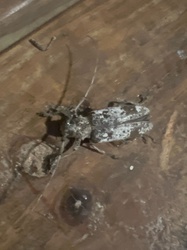
Pine sawyer beetles (genus Monochamus) are large, elongated longhorn beetles built for life on tree bark.
- Size: Typically 3/4 to 1 1/4 inches (18–32 mm) in body length, not counting the antennae.
- Color: A mottled blend of gray, brown, and black that closely matches pine bark, sometimes with faint speckling of lighter gray patches.
- Body shape: Long, cylindrical, and somewhat flattened, with a roughened or granular texture on the thorax (the segment behind the head often has a small spine on each side).
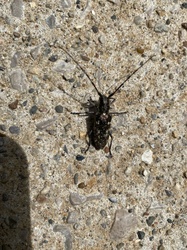
- Antennae: The single most reliable feature — antennae are extremely long and segmented, often exceeding the body length in females and reaching 2–3 times body length in males.
- Legs and wings: Six long legs suited for gripping bark; forewings (elytra) are hardened, dull, and finely textured rather than glossy.
Where and When You'll See One
Pine sawyer beetles are found wherever conifers grow, especially pine, spruce, and fir forests across North America, Europe, and Asia. Look for them resting motionless on tree trunks, cut logs, stumps, or firewood piles, where their coloring provides excellent camouflage. Adults are most active from late spring through summer, and many species are drawn to outdoor lights at night. You may also spot them on recently downed or stressed trees, since females lay eggs in bark crevices of weakened conifers.
Similar-Looking Bugs
- Asian longhorned beetle: Glossy jet-black body with distinct white spots and blue-tinged legs — much shinier and more boldly patterned than the dull, mottled pine sawyer.
- Cottonwood borer: Bold black-and-white checkered pattern, noticeably different from the pine sawyer's earthy brown-gray camouflage.
- Other longhorn beetles: Many species share the long-antennae body plan; focus on the bark-like mottled coloring and habitat (on conifers) to narrow it down to a pine sawyer.
Quick ID Checklist
- Mottled gray-brown-black body that blends with pine bark
- Antennae as long as or much longer than the body
- Cylindrical, roughened body about 3/4–1 1/4 inches long
- Found resting on conifer bark, logs, or stumps
- Often seen at night near lights during warm months
Frequently asked questions
How can I tell a pine sawyer beetle from other longhorn beetles?
Look at the coloring first: pine sawyers have a dull, mottled gray-brown-black pattern that mimics bark, rather than the glossy black-and-white or checkered patterns seen in relatives like the Asian longhorned beetle or cottonwood borer. Habitat is also a clue — pine sawyers are almost always found on or near conifers.
Why are the antennae so long?
Extremely long, whip-like antennae are a defining trait of the longhorn beetle family, and pine sawyers take it to an extreme, with males often sporting antennae two to three times their body length. They use these antennae to sense their surroundings and locate mates and egg-laying sites.
What time of year are pine sawyer beetles most visible?
They're most commonly seen from late spring into summer, when adults are active on bark surfaces and sometimes attracted to porch lights or outdoor lighting after dark.
Do male and female pine sawyer beetles look different?
They look similar in color and body shape, but males typically have proportionally longer antennae than females, which is one of the easier ways to guess the sex of an individual you're observing.
Pine Sawyer Beetle identified by the community
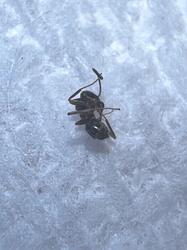
Recent Pine Sawyer Beetle finds identified with Bug Identifier.