Tussock Moth Caterpillar Identification Guide
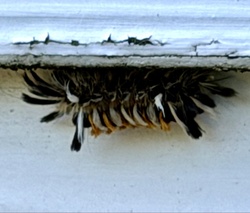
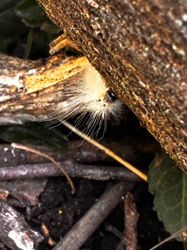
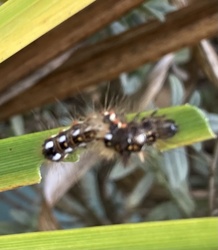
A fuzzy caterpillar bristling with dense hair tufts, including long dark pencil tufts near the head and tail.
Read the full Tussock Moth Caterpillar encyclopedia entry →Key Visual Features
Tussock moth caterpillars are among the most distinctively "hairy" caterpillars, typically reaching 1 to 1.5 inches long.
- Hair tufts: Dense, brush-like tufts of short setae (bristle-like hairs) line the back in a toothbrush pattern, often in white, yellow, or tan
- Pencil tufts: Long, dark, pencil-like tufts of hair project forward from near the head and one or more project backward from the rear
- Color: Body color varies by species but is often black, gray, or dark red with the pale tufts standing out in contrast
- Head/markings: Some species show a bright red or orange head or a colored stripe along the back between the tufts
- Body shape: Moderately stout, obscured largely by the dense hair covering
Where and When You'll See It
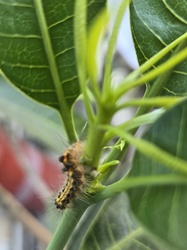
Tussock moth caterpillars feed on a wide range of deciduous trees and shrubs, including oak, maple, birch, and hickory. They are most visible from mid-summer through fall, often seen crawling on tree trunks, sidewalks, or low vegetation as they wander in search of new food or a place to pupate. Their bold, brushy appearance makes them easy to notice even from a distance compared to smoother caterpillar species.
Similar-Looking Bugs
- Woolly bear caterpillars: Also hairy, but covered in a uniform, even coat of bristles rather than distinct tufts and long pencil hairs
- Gypsy/spongy moth caterpillar: Has paired colored dots (blue then red) along its back rather than dense toothbrush tufts and pencil hairs
- Saddleback and other spiny caterpillars: Covered in stiff branching spines rather than soft-looking hair tufts, and lack the long forward and rear pencil hairs
Quick ID Checklist
- Dense, toothbrush-like tufts of hair along the back
- Long, dark pencil tufts projecting from the head and rear
- Body often black, gray, or dark red beneath the tufts
- Found wandering on tree trunks and low plants in summer/fall
- Feeds on a wide variety of deciduous trees
Frequently asked questions
How do I recognize a tussock moth caterpillar?
Look for dense, brush-like tufts of hair arranged in a toothbrush pattern along the back, along with longer dark pencil tufts projecting from near the head and tail.
What is the difference between a tussock moth caterpillar and a woolly bear?
Woolly bears have a fairly even, uniform coat of bristles all around the body, while tussock moth caterpillars show distinct tufts and long pencil hairs rather than an even coat.
Where are tussock moth caterpillars usually found?
They are commonly seen on deciduous trees such as oak, maple, birch, and hickory, and often wander onto trunks, sidewalks, or low vegetation.
When is the best time to spot tussock moth caterpillars?
They are most frequently seen from mid-summer through fall as they feed and later wander in search of a place to pupate.
Tussock Moth Caterpillar identified by the community
Recent Tussock Moth Caterpillar finds identified with Bug Identifier.