Wolf Spider Identification Guide
Tell a wolf spider apart by its robust hairy body, distinctive three-row eye pattern, and ground-hunting habits.
Read the full Wolf Spider encyclopedia entry →Key Visual Features
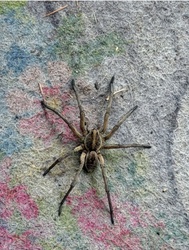
- A robust, hairy body ranging from about 1/4 inch to over 1 inch long, among the larger common ground spiders
- Mottled brown, gray, and black coloring, often with a stripe pattern running along the cephalothorax and legs
- Long, spiny legs relative to the body, built for fast pursuit rather than climbing
- Eight eyes arranged in three distinctive rows: four small eyes in the bottom row, two large forward-facing eyes in the middle row, and two medium eyes in the top row
- The large middle eyes reflect light strongly, producing a noticeable eyeshine when spotted with a flashlight at night, a handy field identification trick
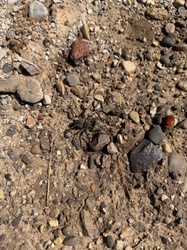
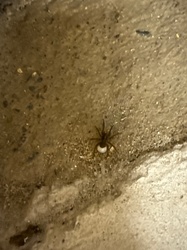
- Females are often seen carrying a round, white-to-tan egg sac attached to their spinnerets, or carrying spiderlings clustered on their back after hatching
Where and When You'll See Them
- Ground-dwelling, found in gardens, leaf litter, grassy fields, under rocks and logs, and in basements
- Hunts prey actively rather than building a web to catch it, often ambushing insects from a hidden position
- Mostly nocturnal, though it can be encountered during the day when disturbed from ground cover or leaf litter
- Some species dig shallow burrows lined with silk that serve as a daytime retreat
- Widespread across most of North America in a wide range of habitats, from woodlands to open fields
Similar-Looking Bugs
- Nursery web spiders are similar in size and color but carry their egg sac in their jaws (chelicerae) rather than attached to the abdomen
- Fishing spiders are typically larger and found near water, often resting on surfaces at the water's edge
- Tarantulas are much larger and hairier, with a different, more tightly clustered eye arrangement
- Jumping spiders are much smaller and more compact, with a stockier build and a different eye layout
Quick ID Checklist
- Robust, mottled brown-gray hairy body
- Distinctive three-row eye arrangement
- Long, spiny legs
- Ground-dwelling with no web
- Females often seen carrying an egg sac or spiderlings on their back
Frequently asked questions
Do wolf spiders build webs?
No, wolf spiders hunt actively on the ground and typically hide in burrows or under debris rather than relying on a web.
Why do their eyes glow at night?
A reflective layer called the tapetum in their large eyes bounces light back, making them easy to spot with a flashlight after dark.
How can I tell a female wolf spider from a male?
Females are generally larger and more robust, while males have noticeably swollen pedipalps near the front of the head.
How is a wolf spider different from a tarantula?
Wolf spiders are much smaller and have a distinct three-row eye pattern, while tarantulas are larger, hairier, and have a more tightly clustered arrangement of eyes.
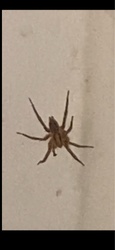
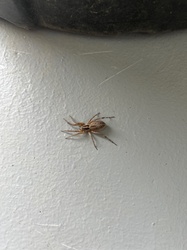
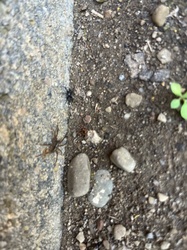
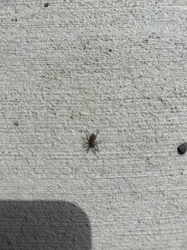
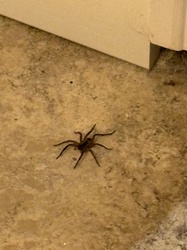
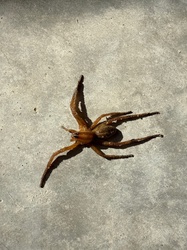
Wolf Spider identified by the community
Recent Wolf Spider finds identified with Bug Identifier.