Black Garden Ant Identification Guide
Learn how to recognize the common black garden ant by its size, dark uniform color, and single-node waist.
Read the full Black Garden Ant encyclopedia entry →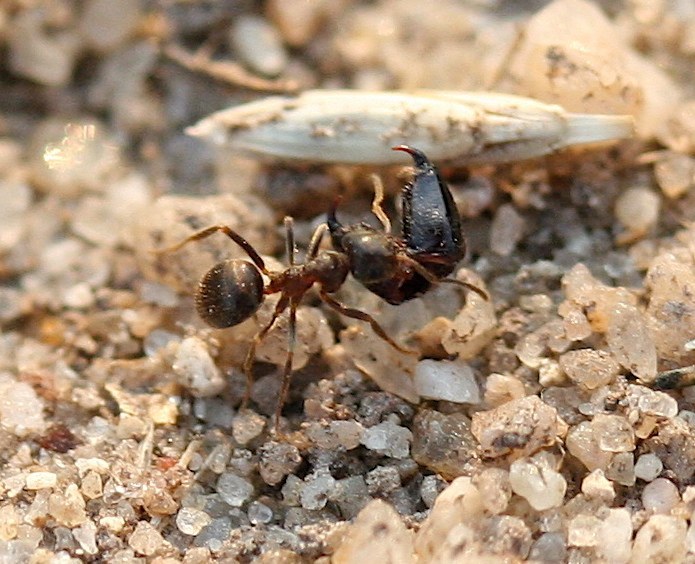
Key Visual Features
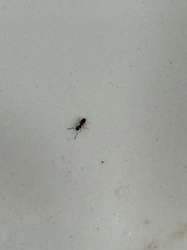
The black garden ant (Lasius niger) is one of the most familiar ants in temperate gardens and yards.
- Size: Workers measure about 3-5mm; queens are noticeably larger, around 9mm, especially when carrying wings before a mating flight.
- Color: Uniformly dark brown to black, sometimes with a faint sheen.
- Body shape: Slender three-part body (head, thorax, abdomen) with a single node (petiole) between the thorax and abdomen, a key trait separating ants from other insects.
- Antennae: Elbowed, bent at a sharp angle partway along their length.
- Legs: Six long, thin legs that allow quick, scurrying movement.
- Wings: Only reproductive queens and males grow wings, and only temporarily before and during their mating flight.
Where and When You'll See It
Black garden ants nest in soil, often under pavement slabs, stones, logs, or at the base of garden plants, leaving small mounds of loose soil at the entrance. Workers travel along visible foraging trails, especially toward aphid colonies they tend for honeydew. Activity peaks from spring through early fall, with dramatic mass nuptial flights ("flying ant day") on warm, humid afternoons in mid-to-late summer, often just after rain.
Similar-Looking Bugs
- Carpenter ants: Larger and more robust, with an evenly rounded thorax profile versus the black garden ant's more uneven, segmented thorax outline.
- Pavement ants: Similar size but usually have lighter-colored legs and fine ridges (striations) on the head and thorax.
- Fire ants and other reddish ants: Distinguished immediately by their reddish-brown coloring versus the black garden ant's solid dark black-brown body.
- Termites (during swarms): Termites have straight beaded antennae, a broad uniform waist, and two pairs of equal-length wings, unlike the ant's elbowed antennae and pinched single-node waist.
Quick ID Checklist
- Small, uniformly dark brown-black body around 3-5mm
- Single node (petiole) visible between thorax and abdomen
- Elbowed antennae
- Foraging trails often lead to aphid-covered plant stems
- Winged forms only appear briefly during summer mating swarms
Frequently asked questions
Are black garden ants the same as the ants seen swarming on "flying ant day"?
Yes. The winged individuals seen swarming in mid-to-late summer are the reproductive queens and males of species like the black garden ant, taking their one-time mating flight.
How can I tell a black garden ant from a carpenter ant?
Carpenter ants are noticeably larger and have a smoothly rounded thorax profile, while black garden ants are smaller with a more segmented, uneven thorax outline.
Do black garden ants always have wings?
No. Only the reproductive queens and males grow wings, and only for a short period around their mating flight; worker ants, which make up most of a colony, are always wingless.
Where do black garden ants typically build their nests?
They commonly nest in soil beneath pavement, stones, logs, or garden plants, often marked by small mounds of loose excavated soil near the entrance.
Black Garden Ant identified by the community
Recent Black Garden Ant finds identified with Bug Identifier.