
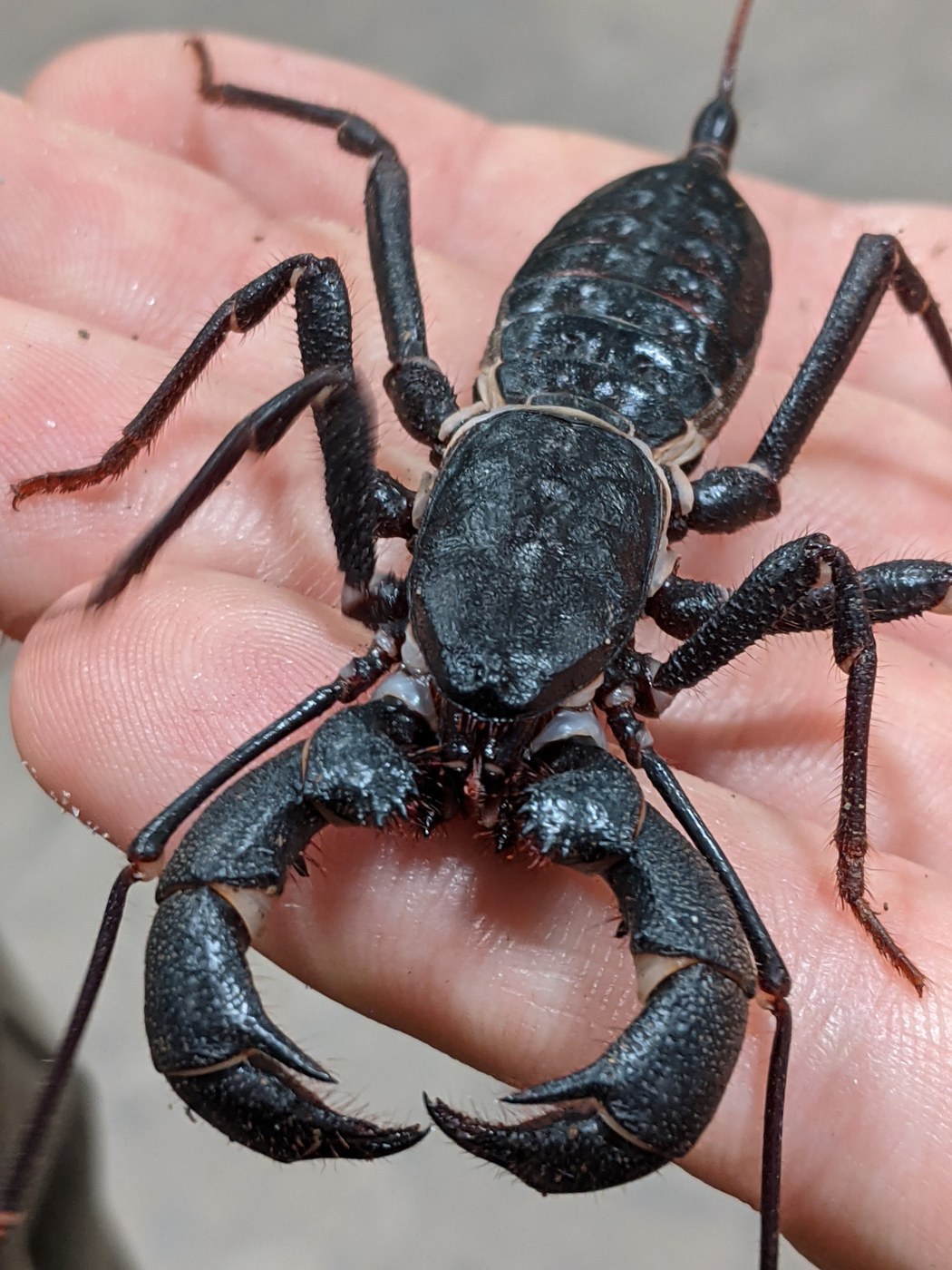
Vinegaroon
Mastigoproctus giganteus
A robust, dark, scorpion-like arachnid whose long, thin whip for a tail gives it its name, and whose signature defense is spraying a concentrated mist of vinegar-scented fluid rather than stinging. Despite its intimidating look, it has no venom at all.
- Size
- Body 4–7 cm plus a thin whip-like tail up to 3 cm
- Habitat
- Arid deserts, scrubland, and grassland soils of the southern United States and Mexico
- Danger
- Harmless
Spotted a bug like this?
Identify any bug or insect from a photo, free.
Overview
The vinegaroon, or giant whip scorpion, is a member of the arachnid order Thelyphonida and the largest species in that group found in North America. It is native to arid and semi-arid regions of the southern United States, including Texas, Arizona, and Florida, extending south through Mexico.
Though it resembles a true scorpion at a glance, with heavy pincer-like pedipalps and an elongated body, the vinegaroon lacks a stinger entirely. In its place is a long, thin, whip-like tail (telson) used for sensing its surroundings, and a pair of glands at its base that give the species its common name.
How to Identify
- Dark brown to black, robust, heavily armored body
- Thick, spiny pedipalps used for grasping prey, sturdier than the pincers of tailless whip scorpions
- Long, thin, whip-like tail (telson) at the rear, lacking any stinger
- Front pair of walking legs is thinner and held forward, used partly as feelers, though not as elongated as in tailless whip scorpions
- Overall bulkier body and shorter legs compared to Amblypygi (whip spiders)
- Adults can reach 6–8 cm including the tail, among the larger arachnids in their range
Habitat & Range
Vinegaroons are found in arid and semi-arid habitats across the southern United States, particularly Texas, Arizona, New Mexico, and Florida, extending into Mexico. They dig burrows in sandy or loamy desert soil and shelter under rocks, logs, and debris, favoring areas with at least some soil moisture.
Behavior & Diet
This species is nocturnal, remaining in its burrow during the day and emerging after dark to hunt insects and other invertebrates using its stout pedipalps. Its defining defensive behavior is spraying a fine mist of concentrated acetic acid, the same compound found in vinegar, from glands at the base of its tail when threatened, which gives the vinegaroon its common name. As a nocturnal predator, it helps regulate populations of the insects and other small arthropods it feeds on within desert soil communities.
Life Cycle
Females dig a burrow in which they lay eggs, carried in a membranous sac attached to the underside of the abdomen until hatching. The pale, spider-like young (praenymphs) then climb onto the mother's back for protection through their first molt, a pattern shared with true scorpions and whip scorpions. Juveniles undergo several molts over more than a year to reach adult size, and adults are largely solitary and long-lived for an arachnid, with some individuals surviving several years.
Frequently asked questions
How does the vinegaroon defend itself?
It sprays a fine mist of concentrated acetic acid, the same compound found in vinegar, from glands at the base of its whip-like tail, which is how it got its name.
Does the vinegaroon have a stinger?
No. Its tail is a thin, whip-like sensory structure (the telson), not a stinger, and the species has no venom.
Where is the vinegaroon found?
It lives in arid and semi-arid regions of the southern United States, including Texas, Arizona, and Florida, and extends south through Mexico.
How is the vinegaroon different from a tailless whip scorpion?
The vinegaroon has a long, thin whip-like tail and a bulkier body with shorter legs, while tailless whip scorpions lack a tail entirely and instead have extremely long, thread-like front legs.
Vinegaroon guides
In-depth guides for identifying, understanding, and living alongside Vinegaroon.
Vinegaroon identified by the community
Real finds identified with Bug Identifier.
Other bugs you may enjoy
Wood Tick
Grassland, shrub-steppe, and open woodland of western North America
Yellow Scorpion
Arid scrubland, rocky slopes, and desert margins
Whip Spider
Tropical caves, rainforest leaf litter, and under bark
Water Mite
Ponds, lakes, streams, and other freshwater bodies
American Dog Tick
Grassy fields, trails, and low vegetation near woodlands
Arizona Bark Scorpion
Rocky desert terrain, tree bark, and structures in the Southwest
Tick
Tall grass, brush, woodland edges, and animal trails
Soil Mite
Soil, leaf litter, moss, and decaying organic matter worldwide
Rocky Mountain Wood Tick
Sagebrush shrublands, grasslands, and montane forest edges
Two-Spotted Spider Mite
Undersides of leaves on garden plants, crops, and houseplants
Spider Mite
Undersides of leaves on garden plants, houseplants, and field and orchard crops worldwide
Whip Scorpion
Tropical and subtropical caves, tree bark, and rock crevices worldwide