Chigger Identification Guide
A nearly invisible, reddish-orange larval mite that clusters in vegetation and is far easier to identify by its bite pattern than by sight.
Read the full Chigger encyclopedia entry →Key Visual Features
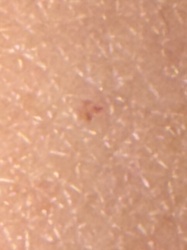
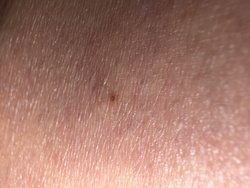
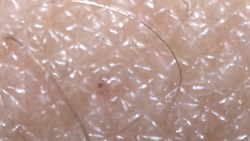
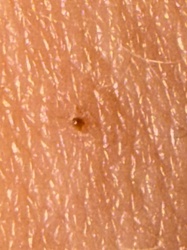
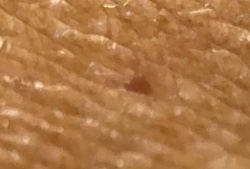
- Extremely small — the larval stage (the only stage that is commonly noticed) measures roughly 0.15-0.3 mm, at or below the edge of unaided human vision, often appearing as a tiny reddish or orange speck.
- Body is oval and covered in fine hairs; under magnification, six legs are visible on the larval stage, unlike adult mites which have eight.
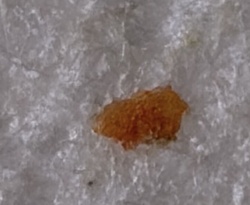
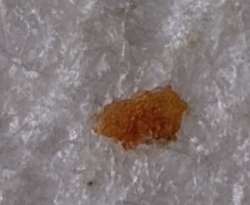
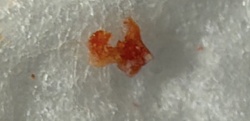
- Color ranges from pale straw-yellow to bright red-orange, which is how clusters are sometimes spotted as a faint reddish dusting on skin, clothing, or vegetation.
- The adult and nymph stages (which do not have the larval feeding behavior) are larger, up to about 1 mm, velvety red, and eight-legged, resembling tiny red velvet mites found in soil and leaf litter.
- Because of their small size, chiggers are essentially impossible to identify with confidence by the naked eye alone; a hand lens or magnification is typically needed.
Where and When You'd See It
- Found in tall grass, weedy fields, brushy edges, forest margins, and shaded, humid vegetation, especially where ground cover is dense and undisturbed.
- Most active during warm months, typically late spring through early fall, and tend to cluster near the tips of grasses and low vegetation, especially in humid, shaded microhabitats.
- Larvae wait on vegetation and transfer onto passing animals or people, often congregating around areas where clothing fits snugly.
- Activity tends to be highest during warm, humid weather and lower during hot, dry midday conditions or cold periods.
Similar-Looking Bugs
- Adult red velvet mites are a similar bright red color but are much larger (up to several millimeters), rounder, and fuzzier, and are typically seen wandering openly on soil or pavement rather than clustering on vegetation.
- Clover mites are also reddish and tiny but tend to be found around building foundations and window sills rather than in tall grass or woodland edges.
- Spider mites are similarly minuscule but are usually pale green, yellow, or red and are associated with plant leaves showing stippled damage rather than open fields.
Quick ID Checklist
- Larval stage is a tiny reddish-orange speck under about 0.3 mm — visible mainly as a faint dusting, not a clear insect shape.
- Six legs on the larval stage versus eight on nymphs/adults, visible only under magnification.
- Found clustered on the tips of grass and low vegetation in humid, shaded, weedy areas.
- Most active in warm, humid months.
- Larger adult/nymph stage resembles a tiny fuzzy red velvet mite found in soil.
Frequently asked questions
Can chiggers actually be seen with the naked eye?
The larval stage is extremely small, around the threshold of unaided vision, so they usually appear only as a faint reddish speck or dusting rather than a clearly visible bug.
How is a chigger different from the red velvet mites I see on the sidewalk?
Adult red velvet mites are much larger, rounder, and wander openly on soil or pavement, while chiggers are the tiny larval stage found clustered in grass and vegetation.
Where in a field or yard are chiggers most likely to be found?
They tend to cluster on the tips of tall grass, weeds, and low vegetation in shaded, humid areas rather than in short, dry, open lawn.
Do chiggers have the same number of legs as adult mites?
No, the larval stage that is typically encountered has six legs, while the larger nymph and adult mite stages have eight.
Chigger identified by the community
Recent Chigger finds identified with Bug Identifier.