
Bird Mite
Ornithonyssus spp.
A minute, pale to reddish mite that lives among feathers and nesting material of wild and domestic birds, sometimes dispersing into nearby buildings when nests are abandoned.
- Size
- 0.5-1 mm
- Habitat
- Bird nests, roosting sites, and structures near nesting birds
- Danger
- Bites
Spotted a bug like this?
Identify any bug or insect from a photo, free.
Overview
Bird mites are a group of small parasitic mites, most commonly represented by species in the genus Ornithonyssus, that live in close association with bird nests and roosting sites. They feed on the blood of nesting or roosting birds and are frequently found among nest material, feathers, and the immediate surroundings of active bird colonies.
These mites are closely tied to their avian hosts for feeding and reproduction, but populations can become mobile and disperse in search of a new blood source if a nest is abandoned or a host bird dies, occasionally leading them into buildings that have birds nesting nearby, such as under eaves or in vents. Once away from a suitable host for an extended time, bird mites typically cannot survive indefinitely.
Bird mites are found worldwide wherever their host bird species nest, and they play a natural, if minor, role as parasites within avian ecosystems, generally causing localized effects around nesting sites rather than broad ecological impact.
How to Identify
- Extremely small, roughly 0.5 to 1 mm long, visible mainly as tiny moving specks to the naked eye
- Pale gray or tan when unfed, becoming darker reddish-brown after a blood meal
- Oval, flattened body typical of parasitic mite species, with eight legs as adults
- Piercing-sucking mouthparts adapted for feeding on avian blood
- Often found in large numbers within nest material, feathers, and cracks near roosting or nesting sites
- Difficult to distinguish from closely related mite species without microscopic examination
Habitat & Range
Bird mites are distributed globally, occurring wherever their host bird species build nests, including wild bird nests, poultry housing, and man-made structures such as roof spaces, vents, and eaves used by nesting birds like sparrows, pigeons, or starlings. They concentrate heavily within nest material itself.
The mites depend on regular access to a bird host for blood meals and tend to remain closely associated with active nests, though they may spread short distances into adjacent structural spaces, particularly after a nesting season ends or a nest is vacated.
Behavior & Diet
Bird mites feed on the blood of nesting and roosting birds, typically remaining within or very near the nest structure where their host is present. Their feeding and reproductive activity is closely synchronized with the nesting cycle of the host bird species.
When a nest is abandoned, whether due to fledging of young birds or nest failure, mite populations may become more mobile, dispersing in search of an alternative blood source, which occasionally brings them into contact with nearby structures. Ecologically, bird mites are host-specific or host-associated parasites that form part of the broader parasite community linked to wild and domestic bird populations.
Life Cycle
Bird mites develop through egg, larval, nymphal, and adult stages, with blood meals typically required to progress through the later developmental stages. Under warm conditions the full life cycle can be completed in a relatively short period, often within one to two weeks, allowing rapid population growth during an active nesting season.
Reproduction and population buildup are closely tied to the presence of nesting birds, with mite numbers typically peaking while young birds are in the nest and declining after fledging as the host source diminishes. Without access to a blood meal, bird mites generally have a limited survival time away from nests.
Frequently asked questions
Where do bird mites typically come from?
They originate from active bird nests, most often built in eaves, vents, or other structures near buildings, and are closely tied to the presence of nesting or roosting birds.
What happens to bird mites after a nest is abandoned?
When their host birds leave or a nest fails, mite populations may disperse locally in search of another blood source, though they cannot survive indefinitely without access to a host.
How can bird mites be identified?
They appear as extremely tiny, pale to reddish-brown specks, generally requiring magnification to see clearly, and are usually found concentrated within nest material.
Do bird mites live permanently on their host bird?
No, many bird mite species spend significant time within the nest material itself rather than continuously on the bird, feeding periodically when the host is present.
Bird Mite guides
In-depth guides for identifying, understanding, and living alongside Bird Mite.
Bird Mite identified by the community
Real finds identified with Bug Identifier.
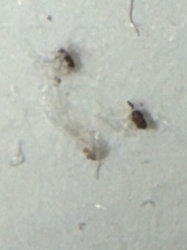
Other bugs you may enjoy
Wood Tick
Grassland, shrub-steppe, and open woodland of western North America
Yellow Scorpion
Arid scrubland, rocky slopes, and desert margins
Whip Spider
Tropical caves, rainforest leaf litter, and under bark
Water Mite
Ponds, lakes, streams, and other freshwater bodies
American Dog Tick
Grassy fields, trails, and low vegetation near woodlands
Arizona Bark Scorpion
Rocky desert terrain, tree bark, and structures in the Southwest
Tick
Tall grass, brush, woodland edges, and animal trails
Soil Mite
Soil, leaf litter, moss, and decaying organic matter worldwide
Rocky Mountain Wood Tick
Sagebrush shrublands, grasslands, and montane forest edges
Two-Spotted Spider Mite
Undersides of leaves on garden plants, crops, and houseplants
Spider Mite
Undersides of leaves on garden plants, houseplants, and field and orchard crops worldwide
Whip Scorpion
Tropical and subtropical caves, tree bark, and rock crevices worldwide